
Dec. 20, 2025
Why don’t people who choose to be homeless just get a job or at least agree to go into a shelter or rehab?
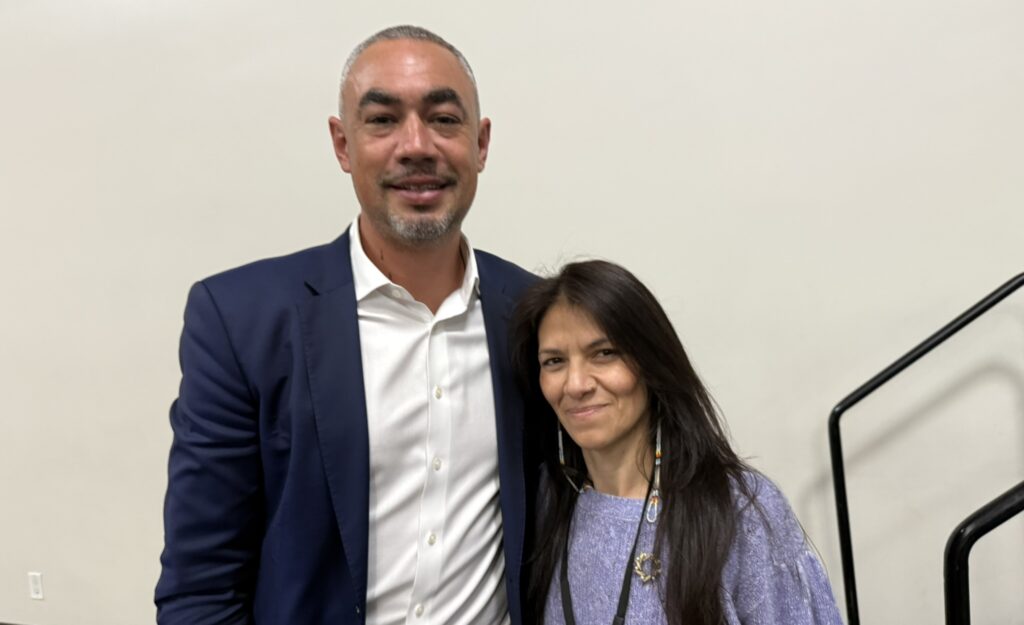
Those are the kind of comments that are particularly heartbreaking, and maybe infuriating, to Natalie Raschke.
“There are a lot of times or moments when you feel guilt-shamed for not taking what is offered,” she said. “But just because I’m homeless doesn’t mean that I’m going to take whatever is offered to me.”
Natalie and her husband Dustin didn’t choose to be homeless. They didn’t need rehab and they were healthy and smart, but also had four children to care for and had limited options for shelter.
The couple once had a good life in Sacramento, where they were raising their children and had bartending jobs with money to spare.
That began to change when the pandemic hit and the world shut down in 2020. Out of work but with a decent savings account, they bought a recreational vehicle with a plan to move into an RV park in San Diego, where the couple previously had lived, while waiting for the lockdown to end.
Just two weeks after arriving in September 2020, however, the couple was told their family was too large to stay in the park, and they had to leave. Unable to find another park to take them in, they began parking on city streets.
Money ran low and parking fines piled up. They were able-bodied, stable, college educated and willing to work, but despite all they appeared to have going for them, they also were homeless.
The experience was eye-opening for Natalie, who said she was disappointed to discover how judgmental and outright cruel others could be during the time they parked their RV at Mission Bay.
Some people would shine their headlights at their vehicle at night just to let them know they were not welcomed. Other homeless people in the area, however, became like an extended family whom the couple came to trust.
As time went by, Natalie had other revelations. The system in place to help homeless people can be confusing, frustrating and ineffective, she learned.
“I don’t have a learning disability,” she said. “I don’t have a physical disability. And for a person with a college education to navigate through what they were requiring us to do was almost impossible.”
That frustration inspired her to contact local media, which led to a feature story by Lisa Halverstadt in Voice of San Diego. Three days after the story appeared in June 2022, the family received an emergency housing voucher from the San Diego Housing Commission.
That same month, Natalie spoke before the San Diego City Council about the challenges of families living in their vehicles, and Councilmember Sean Elo-Rivera requested the city assess property for more safe-parking sites in the city.
“I can’t speak for my other colleagues, but I think that the story was powerful,” Elo-Rivera said about the impact of the story on the Raschkes. “It was on people’s radar, and then having her come to council put it in front of people’s faces.”
The council later agreed to allow vehicles to stay for 24 hours at a Mission Valley safe parking lot, which led to more RV owners using it.
The story had other unexpected reactions. While the Raschkes did experience some hostility from people during their two years of homelessness, they also received an outpouring of compassion and support once their story was told.
“It was overwhelming that so many people did want to reach out and wanted to help,” Natalie said. “But I also kind of felt guilty, because I’m not the only one.”
Today, the couple and three of their children – ages 8, 12 and 16 – are living in a subsidized apartment while their oldest, 18, is in Sacramento.
Dustin works for a pool-service company and Natalie works for Lived Experience Advisors, where she continues to be an advocate for homeless people. She also was a guest on the Nov. 4 edition of the Homeless in San Diego podcast hosted by Interfaith Community Services CEO Greg Anglea.
Among her advocacy work, Natalie has assisted a street medicine team with homeless outreach in Orange County, which was a topic in a panel discussion she participated in at the 2024 RTFH conference.
The family’s story illustrates the false generalizations that are often made about homeless people, who sometimes are characterized as having “chosen” to be homeless or being the victim of their own poor choices and lifestyles.
Their story also shows how things can spiral even further downward once someone experiences homelessness, making it that much more difficult to find a way out.
Things looked up when Dustin got a job at a grocery store in early 2022, and the couple decided to give the family a break by renting a hotel room when his first paycheck came in.
The next morning, they discovered their RV had been towed. They later learned that with unpaid fines against their vehicle, it would cost $4,800 to get it out of impound. They let it go to focus on saving money for an apartment and used what money they had saved to buy a van to live in.
As related in the VOSD story, the couple sometimes paid up to $45 to submit apartment applications without getting a response. While their family income didn’t qualify them for some apartments, they at times paid more in hotel bills than they would have in rent.
Another often-repeated assumption is that homeless people routinely decline help or shelter. Natalie is quick to give another perspective.
“It’s really hard to figure out where to start,” she said. “You call 2-1-1 (the county’s helpline for resources), and every time you might get a different answer. You retell your story, and every time you retell your story, you want to say, just forget it, how many times do I have to say this?”
Natalie said the family also had their reasons for turning down offers to stay in a shelter. One facility was far from where their children attended school, and she didn’t like that people in rehab were so near families.
Natalie also said she was offended that she was asked to urinate in a cup to prove she was drug-free.
“I’ve never been in trouble with the law,” she said. “To me, that’s pretty invasive just to get my kids off the street. So to sleep in a room with my children, I have to pee in a cup. Well thanks, but no thanks.”
Restrictions also included a prohibition against toaster ovens in rooms, which Natalie thought was a ridiculous condition.
“I had to ask, ‘Why can’t I have a toaster oven?'” she said. “He said they worry about fires. I’m like, how the heck am I going to start a fire with a toaster? What are we talking about?”
Natalie is continuing to share her family’s story to give a greater insight into the real experiences of homelessness. While finding time for an interview for this story, she already had met with two San Diego City Council members that morning and had another scheduled for that afternoon.
Their story may not be over. As the year’s end approached, the family was notified that funding changes at the federal level mean their housing voucher will expire in the coming year, long before it was intended to end.