
Oct. 28, 2026
The latest update to the Encinitas Homeless Action Plan could use more action, Mayor Bruce Ehlers and others said at the Oct. 28 City Council meeting.
“I need goal statements that are clear and upfront,” Ehlers said. “The way the document is organized right now, I’m looking for an action plan. I want action. I want deliverables.”
Community Resource Center Chief Program Officer Rebecca Nussbaum had a similar comment during the meeting.
“An action plan needs actionable commitments,” she said. “The staff presentation, as well as what’s in the HAP, currently describes that there will be implementation timelines, responsibilities and measurable performance indicators, and that those will be developed after the plan is adopted.”
Nussbaum said those are essential components of an action plan, and she encouraged the council to establish the commitments before the plan is adopted so the community knows what actions will be taken and how progress will be measured.
A city staff member said the feedback would be used for revisions to the draft.
“We did get good directions, and I know we appreciate it,” said Development Services Director Scott Drapkin. “So we can definitely go back to the drawing board on this a little bit.”
Overall, the draft Homeless Action Plan presented to the council showed positive progress in the city, and council members said they had noticed the improvement.
“I know there’s some hot spots, but it is a night and day difference from when I first got on the council and now,” said Councilmember Marcos San Antonio.
The city’s original Homeless Action Plan was adopted in February 2021, and the updated draft of the 2026-31 action plan was presented to the council by Homeless Program Coordinator Crystal Pugh.
“The plan places a strong emphasis on understanding the needs of individuals and families experiencing homelessness in Encinitas, ensuring that strategies are grounded in accurate and current local conditions,” she said.
New in the plan is a focus on prevention and diversion, which Pugh said stabilizes residents before they lose housing and reduces a reliance on shelters.
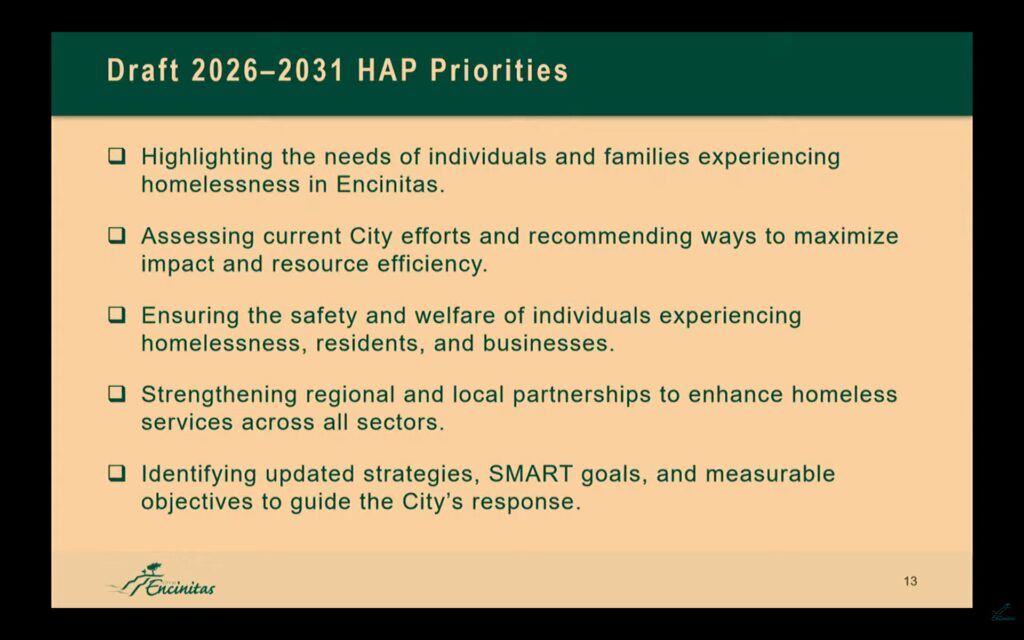
Encinitas’ draft Homeless Action Plan update includes priorities through 2031.
“These strategies align with national best practices and support stronger, more cost-effective outcomes,” she said.
The original three goals of the action plan from 2021 were to increase capacity to end homelessness through a collaborative approach, decrease homelessness through a demand-driven, person-based response system and increase availability of temporary and permanent housing.
Goals added since then are to promote public safety and community well-being and to use data to drive accountability and results.
The plan included a summary of successes over the past two years, including:
The plan also noted the city had “identified alternative funding sources such as securing additional outreach services at no additional cost to the city by supporting San Diego Rescue Mission’s grant application with a letter of support. This demonstrates innovative resources, leveraging rather than increasing general fund reliance.”
The City Council, however, declined to apply for a $3.9 million grant from the state Encampment Resolution Fund to house unsheltered people, connect them with services and clear encampments.
Ehlers brought up the decision when commenting that the action plan did not mention that the city had shifted from a housing-first to a treatment-first approach by contracting with the San Diego Rescue Mission.
“We went as far as to say we would not accept money under false pretenses and apply for a grant, a multimillion-dollar grant, because it required housing first,” he said. “And so that needs to be stated in here, right in the front.”
Paul Armstrong, chief operating officer with the Rescue Mission, gave some clarification about how they treat clients.
“Our goal is to resolve their homelessness,” he said. “I think sometimes, if I could just be honest, treatment first, housing first,’ those become just words. Our commitment and our pledge is we’re going to help that person.
“And we do know that for them to have stability, that does mean if they have a substance use disorder, we’re going to get them into treatment,” he continued. “If they have mental health issues, we’re going to make sure that they’re connected to behavioral health resources. So we’re going to do everything we can to be able to get that person connected, with the goal of ending their homelessness.”
Some council members also saw the plan, which runs 83 pages when including a glossary, appendixes and community comments, as too dense.”
During public testimony at the meeting, an audience member said the plan was an oversized volume for a relatively small problem, as only 64 unsheltered homeless people were found in the January point-in-time count that included Encinitas, Del Mar, Solana Beach and San Dieguito.
The latest count was a 30% reduction in unsheltered homeless people from the previous year.
But there have been setbacks in the past year. Councilmember Joy Lyndes noted that the city’s safe parking lot for homeless people living in vehicles closed in December 2025, contributing to the reduction in the count the following month.
“We lost that safety net for people who no longer have traditional housing and only have their car, and I would like to see us in the future reconsider that,” she said.
During the public comment portion of the meeting, some residents objected to any plan to expand services in the city because they believed they would attract more homeless people to Encinitas.
One person said the city should not apply for any grants to assist homeless services, but rather do a better job with what they already have.