
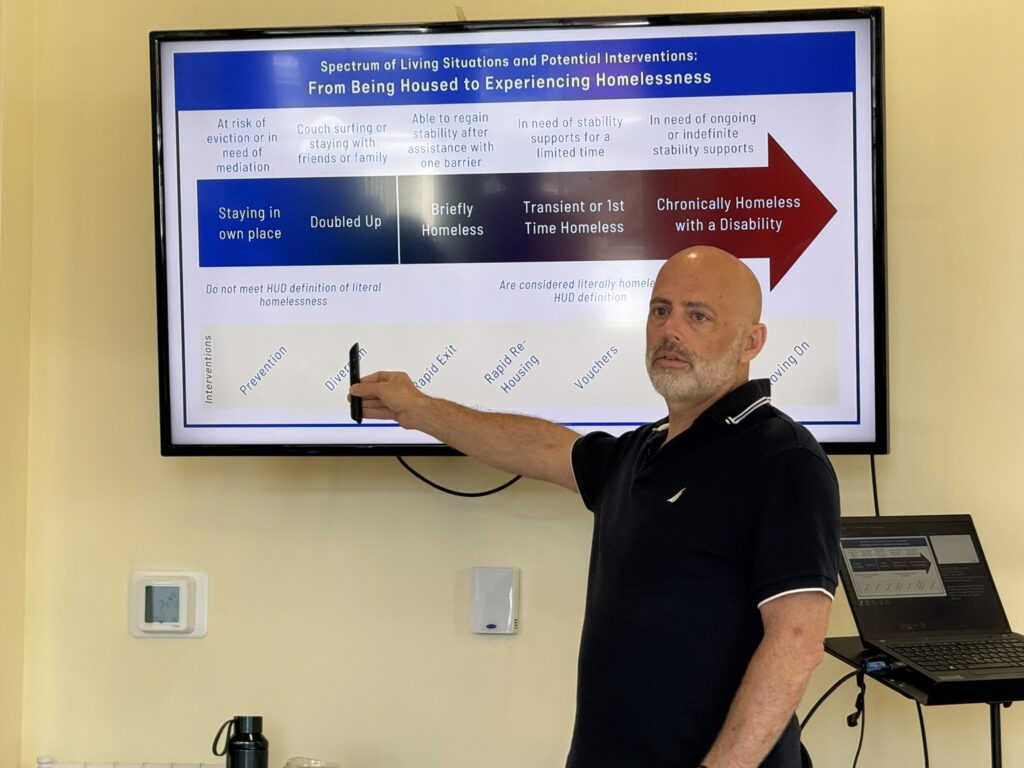
A large homeless encampment in Lemon Grove had been a sore spot in the city for years. Past efforts to clear it had been unsuccessful, and residents and business owners were growing impatient with city officials.
Then in August 2025, a team of service providers and homeless practitioners moved in, backed with an $8.4 million grant from the state’s Encampment Resolution Fund. The goal was to provide housing over two years for 102 people and provide services for 170 people in all.
Crews from the city of Lemon Grove, Impact Group, Crisis House, Brilliant Corners and RTFH (Regional Task Force on Homelessness), the lead applicant for the state grant, worked together over five weeks to completely clear the encampment and find homes and wraparound services for about 30 people.
These are the stories of how it happened, who was helped, and the businesses, residents and city officials cheering on the change.
Lemon Grove ERF 2: Training Day
Sept. 8, 2025
After five years living in a Lemon Grove encampment, Cardell Turner had heard promises before.
He recalled offers of housing or shelter from people who would show up but never return, each time leaving the people on the street a little more cynical.
Not surprisingly, he and others around him had the same doubts when outreach workers from the nonprofit Crisis House showed up on the street in August.
“Nobody believed them,” he said. “We were all talking that night, like, ‘Yeah, they’re coming back. Right.'”
But this time was different. The crews not only came back, but they helped people renew identification cards, find lost paperwork and even drove them to apartments so they could choose the place they wanted to live.
Just days after his initial contact with the crew, Turner was one of the first people from the encampment to move into an apartment.
“I cried this morning because it’s real,” he said while sitting on the edge of the bed in the room that is subsidized for the next two years. “It’s real now.”
Down the hall, Elliott Bender recalls how he also did not believe the offer at first, and is overwhelmed by how quickly his life has turned around.
“A week ago, I was fully living in a tent with no real prospects,” he said.
He also had been skeptical, having heard about other groups who had offered services or other help, only to see those promises fall through.
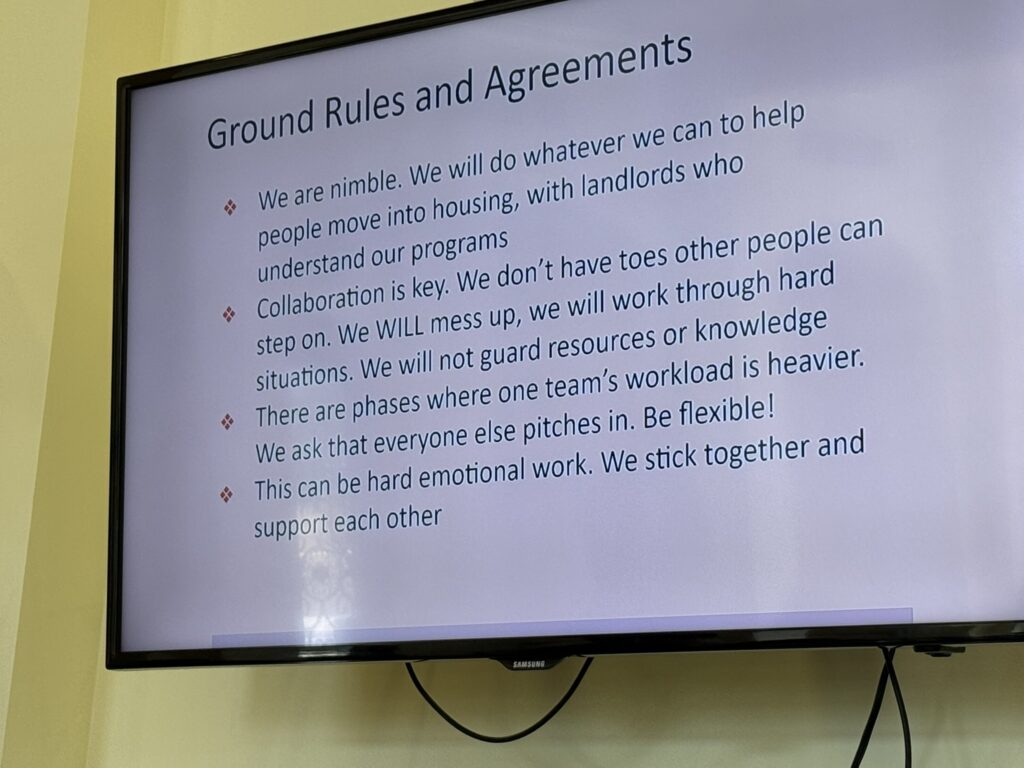
Collaboration and flexibility are listed as some of the ground rules and agreements at the Lemon Grove ERF.
“I was hopeful, but I’d say somewhat skeptical, if not dubious, because I’ve heard mixed reviews of these agencies,” he said. “And sometimes it was less than stellar. But not in this case, thankfully. This has been a turnaround.”
While that turnaround appears to have happened overnight, it actually was the culmination of months of planning and coordination between RTFH (Regional Task Force on Homelessness), the city of Lemon Grove and several partners.
The effort in fact dates back to 2021, when the state of California created a $50 million Encampment Resolution Fund (ERF) as a competitive grant program for cities to clear tents and makeshift shelters.
The fund significantly grew over the years and reached $900 million this year. The strategy also evolved, and now has an emphasis on housing rather than just moving homeless people out of encampments.
In Lemon Grove, $8.4 million in ERF money has been allocated to clear encampments in the city. RTFH was the lead applicant for the grant, which will fund housing over two years for 102 people and provide services for 170 people in all.
The new approach follows a strategy championed by The Impact Group involving a multi-pronged team acting in unison along every step, from initial contact from outreach workers to moving people into subsidized homes with connections to services. The strategy was used just once before in the county with a $11.3 million ERF project in Oceanside and Carlsbad earlier that year, also coordinated by RTFH.
By the time crews had cleared the encampment of 24 tents and 30 tons of debris from Buena Vista Creek in Oceanside, 76 people had been offered help and 54 people had moved into subsidized housing. With money left to spend and more encampments to clear, the ultimate goal is to house 196 people and provide services to 350 people.
The Lemon Grove effort is taking a slightly different approach, with a goal of housing more people for less money. Of the 102 people who will be housed, 75 will receive two-year rapid-rehousing subsidies and 27 will secure housing by connecting them with existing resources, a strategy known as diversion assistance.
Leading up to the Lemon Grove launch, which will focus on several encampments in the city, RTFH held two days of meetings in early August with ERF partners, including the city of Lemon Grove, People Assisting the Homeless, Think Dignity, The Impact Group, Family Health Centers, Brilliant Corners, Caltrans and Crisis House, a local nonprofit leading the outreach.
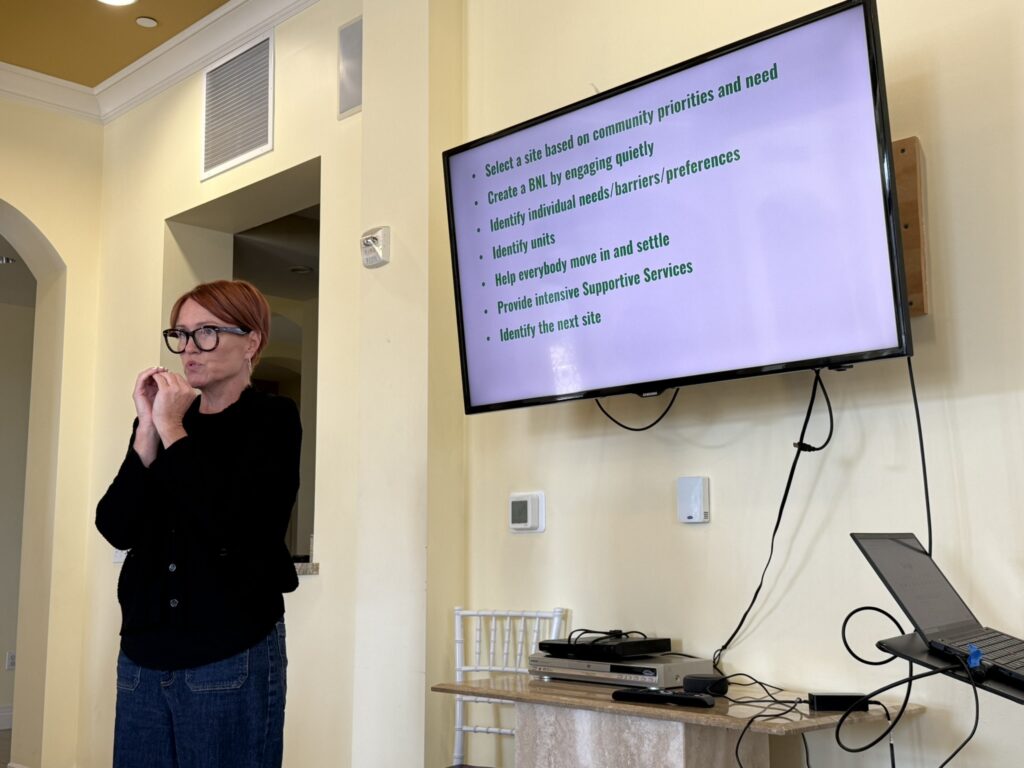
Melanie Zamora of the Impact Group gave advice to outreach workers as they prepared to help homeless people in a large Lemon Grove encampment. Photo by Gary Warth.
Discussions involved the careful, preliminary steps taken behind the scenes, with representatives from different partners telling others about their roles and at times offering advice.
“Roles and responsibilities are really important,” said Melanie Zamora of The Impact Group, an RTFH consultant. “There’s a lot of overlap. We will all be out on the site a lot.”
Zamora also spoke of the importance of getting to know each individual on the site and that person’s needs.
“Not every single person we move into housing from the encampment is going to need daily case management,” she said. “I don’t think every one of them is going to need weekly case management. But if we don’t know what that individual person’s needs are and what’s going to help them stabilize in housing, that’s a problem.”
“Zamora also gave advice on safety, cautioning people to always go out with a buddy and to trust their senses.
Carlos Amaya of Caltrans added another precaution and advised people to bring a spare pair of shoes because of what they may step on, including discarded hypodermic needles.
Ed Boyte, an expert in diversion strategies and founder of The Listening Group, advised the group on how to have productive, nuanced conversations with people seeking housing.
“Don’t ask, ‘Do you want a one bedroom or a studio?’ or “Do you want a roommate?'” he said, explaining that such questions likely will result in people saying they want a room to themselves.
Instead, Boyte suggested asking open-ended questions about a person’s past living situations and having discussions about the cost-saving benefits of shared housing. He also shared subtle strategies such as seating arrangements that can help build trust and foster positive energy.
“I’m not trying to problem-solve at this point, but to listen and understand,” he said.
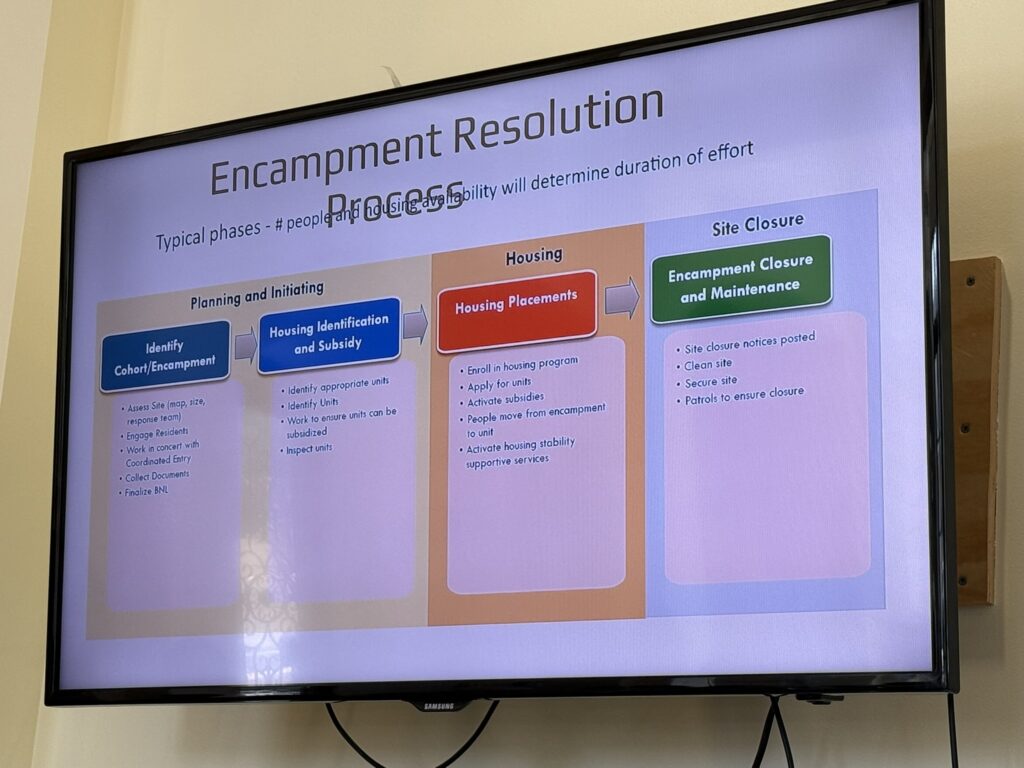
The Lemon Grove ERF involved planned steps from planning to housing and encampment closure.
About a week after the training, members of RTFH, Crisis House and the Impact Group began creating a by-name list of 38 people on North Avenue. On Aug. 18, outreach teams began hitting the street.
Some of those on the street, including Turner and Bender, would be doubtful when approached and told about housing opportunities, but would learn it was really happening as they turned the key to their apartment.
Speaking at a City Council meeting that month, Lemon Grove Mayor Allyson Snow acknowledged that the people in the encampment had reason to be skeptical.
“For a long time our solution has been to clean up an encampment and watch our people cross the street and start another encampment,” she said. “That is not a solution. It’s compounding the problem.”
The city had worked with a local nonprofit to address homelessness in the past, but did not have the resources to provide housing to the people they were trying to help, which Snow said created distrust among the homeless population.
“We have the audacity to think we could do something and reverse homelessness in our community and actually get people housed and get people services,” she said about the new approach made possible with the state funds.