
A large homeless encampment in Lemon Grove had been a sore spot in the city for years. Past efforts to clear it had been unsuccessful, and residents and business owners were growing impatient with city officials.
Then in August 2025, a team of service providers and homeless practitioners moved in, backed with an $8.4 million grant from the state’s Encampment Resolution Fund. The goal was to provide housing over two years for 102 people and provide services for 170 people in all.
Crews from the city of Lemon Grove, Impact Group, Crisis House, Brilliant Corners and RTFH (Regional Task Force on Homelessness), the lead applicant for the state grant, worked together over five weeks to completely clear the encampment and find homes and wraparound services for about 30 people.
These are the stories of how it happened, who was helped, and the businesses, residents and city officials cheering on the change.
Lemon Grove ERF 4: The Caravan
Aug. 16, 2025
The white Crisis House van pulled away from the North Avenue encampment and headed east toward El Cajon.
Inside, Jennifer Carnes cradled her 9-week old puppy Monse. Robert Reid sat nearby, looking out the window and Raenal Smith sat in the back.
“The only thing that’s worked out for me is my dog,” Carnes said as she reflected on what her life has been like since moving from Colorado to California in January.
The three had been living in the encampment and were being offered housing and wraparound services as part of the $8.4 million state Encampment Resolution Fund project overseen by RTFH (Regional Task Force on Homelessness), the City of Lemon Grove and several partners.
Among those partners is the supportive housing program Brilliant Corners, which has worked in partnership with RTFH since 2020 to locate homes for people experiencing homelessness and provide tenancy support to ensure long-term housing stability.

Jennifer Carnes and her puppy, Monse, stand outside their car in Lemon Grove. Photo by Gary Warth.
On this day, Carnes, Reid and Smith were participating in a housing caravan, one of many that would happen during the ERF project that launched in August.
The van pulled up to a single-room occupancy housing complex where they were greeted by a property manager who showed them a clean but small, 9 by14-foot room. Each room came with a television and small closet, and tenants shared a bathroom down the hall and a large common area with several stoves, microwave ovens, six refrigerators and a long oak picnic table.
“Oh, this is cool,” said Leeanne Ward, a senior housing coordinator with Brilliant Corners as she viewed the room.
Reid knew the kitchen well, having lived at the SRO for several years before moving out and becoming homeless when the rent increased from $1,150 to $1,250 in January.
He has been living in a tent since then, but likes to keep his appearance up.
“The secret to homelessness is not to look homeless,” he said, pointing out his clean boots, pants, button shirts and recent haircut.
The SRO had potential, but the no-pets policy was a dealbreaker for Carnes, who later would move into an apartment in the Midway District.
Back at her car where she lives with Monse, Carnes picked up a torn piece of cardboard where she had written, “Hungry, anything helps.”
“The struggle is real,” she said. “Even if you just ask for a dollar, they say stuff like, ‘Why don’t you get a job.’ Try getting a job when you’re homeless.”
Smith passed on the unit because of the no-guest policy.
“It had way too many restrictions,” he said.
But there were other options. Rather than offering a single take-it-or-leave-it choice for housing, Brilliant Corners and the caravans empower people to make their own housing choices, and Smith said he liked a place he saw in Spring Valley.
Smith, 65, has been homeless since his divorce six and a half years ago, and he had spent five months living in his car on North Avenue.
“I’m a diabetic and I do dialysis three times a week,” he said. “I’m trying to get myself together, trying to find a place.”
He receives $1,220 a month in disability payments and has no other income. A former truck driver and professional umpire, Smith said he no longer works because of his health condition, but also realizes he may have to find some additional income to pay rent.
“I’m on disability, but it’s not enough,” he said. “I’m going to have to find some company that will hire me.”
A few days later, Smith met with Brilliant Corners housing specialist Andrew Campos and property owner Arthur Allen outside Allen’s Spring Valley apartment complex, where they chatted while Smith’s room was being prepared.
Campos recalled meeting Allen by cold-calling him a week earlier, a common practice when looking for vacancies.
“Just like a sales person looks for leads all day, that’s what a housing specialist does,” he said.
Campos saw the Spring Valley complex as a good fit for their clients because it was close to Lemon Grove, but Allen had his doubts at first.
“Everybody is skeptical in the beginning,” Campos said. “Arthur wasn’t interested in the very beginning, but I managed to secure a time to see the place and bring a few clients just so he could see who we are, what our process looks like, who our clients are. “
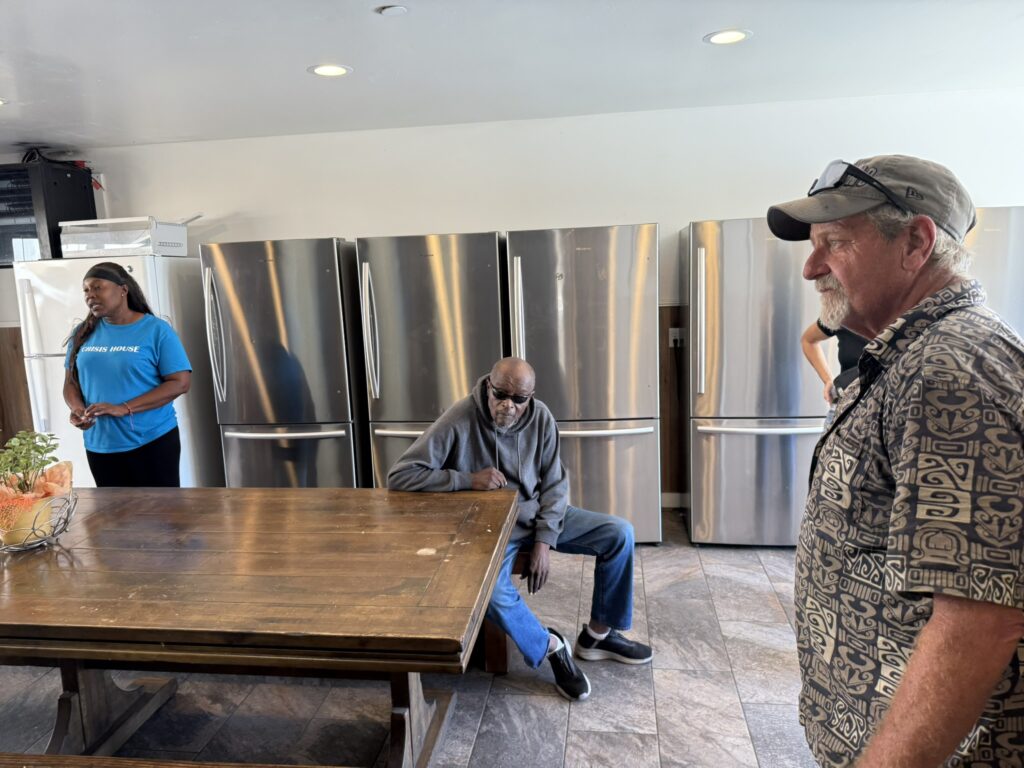
Lawanda Sullivan, Raenal Smith and Robert Reid examine a kitchen and common area that was part of an apartment unit offered as housing for people at a Lemon Grove encampment. Photo by Gary Warth
Campos said Allen was still a bit hesitant, but he continued to build rapport with him and introduced him to his Brilliant Corners teammates.
“Over the course of a few days, after a few more conversations with our colleagues and some testimonials with our other landlords, Arthur was a little more comfortable to proceed,” he said.
When first introducing the program to a landlord, Campos said he tells them about the subsidy that will come with a client, an assurance that rent will be paid. Tenants also will have renters insurance, deposit assistance and other safeguards.
“These are all just things we have in place to accompany somebody that’s moving in, and a lot of the time, that actually makes a landlord feel more at ease than even an open-market tenant would be, because they’ll come with all these protections,” Campos said.
While housing specialists work with landlords, Campos said housing coordinators work with clients and regularly check with the tenant and a case manager to make sure things are going smoothly.
“With Arthur, I was up front and let him know that this is a project that we just started working on, and we’ve been tasked with clearing this encampment,” he said. “Some people might have some issues in their history, but what gives the landlord peace of mind at the end of the day is that there’s a team behind whoever moves into this place that will be at their beck and call. They are one call or text away whenever issues rise up.”
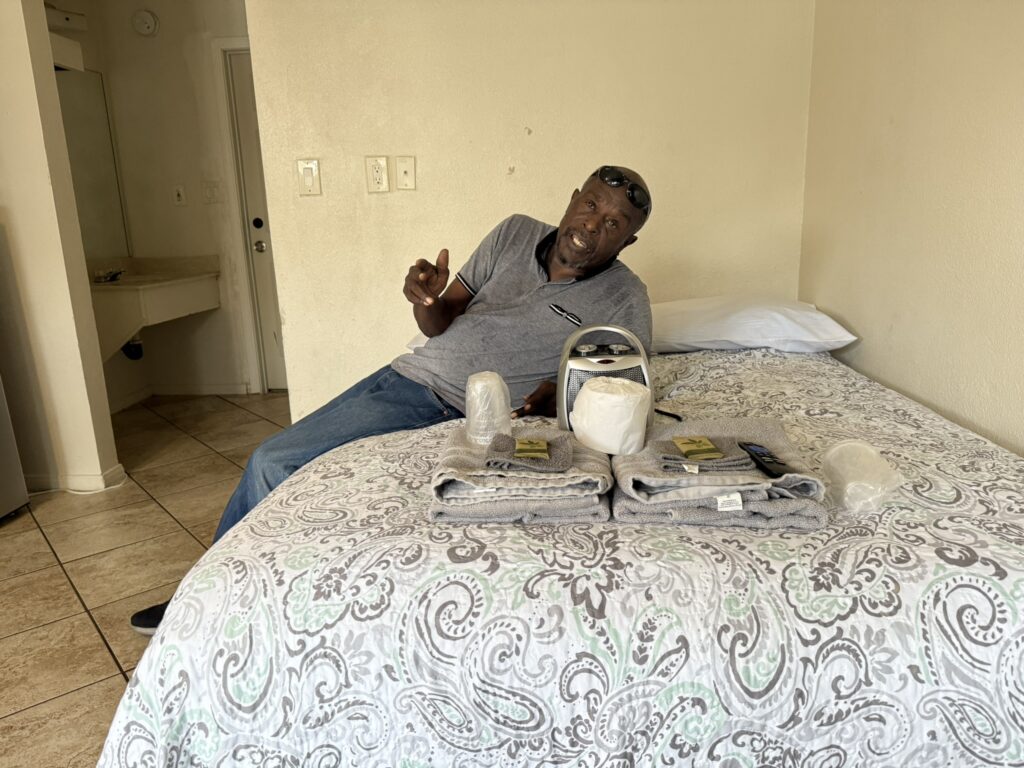
Raenal Smith tries out his new bed, which he said was a significant upgrade from sleeping in his car. Photo by Gary Warth
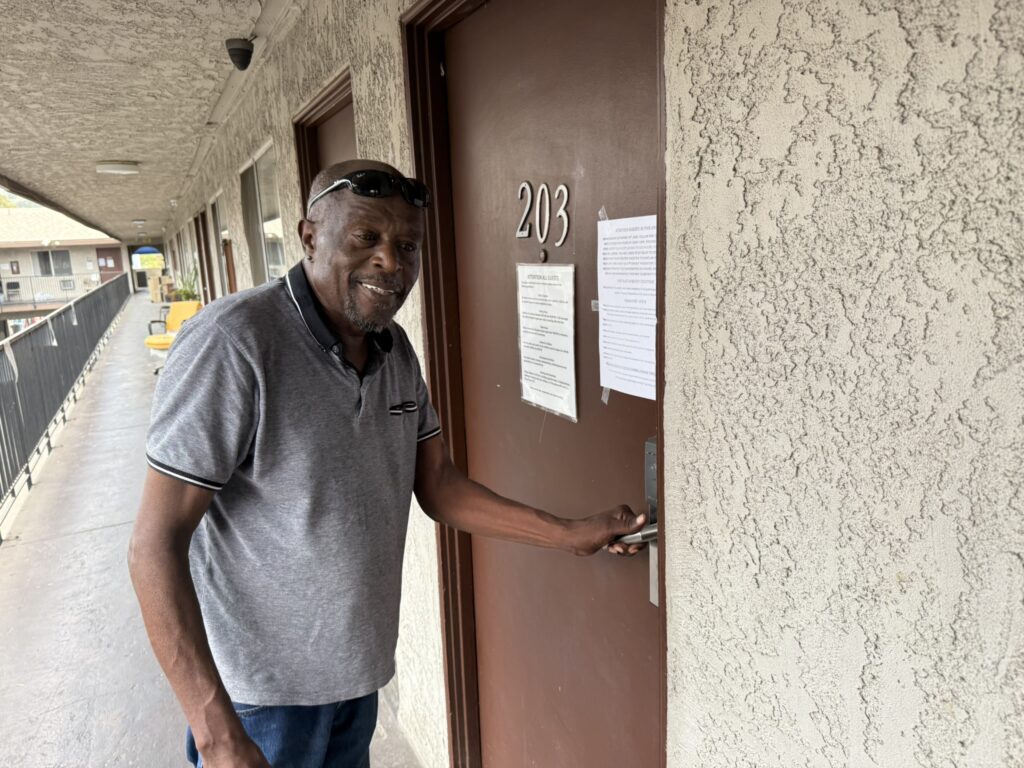
When Smith’s apartment was ready, he was handed a key card and walked upstairs with Allen and Campos. He slid the key into the slot, smiled and walked into his new home.
“Thank you guys,” he said. “This is really important. Thank you. Thank you. I’m very much blessed.”
Smith walked to the back of the room and gazed at the folded towels and space heater on his new bed.
This would be quite an improvement over sleeping in a car with a cracked windshield that leaks when it rains, he said.
“I’m going to sit here and smile,” he said when asked what would be the first thing he does in the room. “It’s been such a long time to come to your own place, to say I have a place where I can go and relax, enjoy myself.
“I don’t have to worry about where I’m going to sleep,” he added.