
A large homeless encampment in Lemon Grove had been a sore spot in the city for years. Past efforts to clear it had been unsuccessful, and residents and business owners were growing impatient with city officials.
Then in August 2025, a team of service providers and homeless practitioners moved in, backed with an $8.4 million grant from the state’s Encampment Resolution Fund. The goal was to provide housing over two years for 102 people and provide services for 170 people in all.
Crews from the city of Lemon Grove, Impact Group, Crisis House, Brilliant Corners and RTFH (Regional Task Force on Homelessness), the lead applicant for the state grant, worked together over five weeks to completely clear the encampment and find homes and wraparound services for about 30 people.
These are the stories of how it happened, who was helped, and the businesses, residents and city officials cheering on the change.
Lemon Grove ERF 5: Think Dignity fills in the gaps
Retrieving lost paperwork and renewing documents may not be as dramatic as handing a homeless person keys to their new home, but they can be just as important when getting someone housed.
“We take for granted something so basic as your ID,” said Kimberly Grady, executive director of Think Dignity, a nonprofit whose mission is “To inspire, empower, and organize our community to advance basic dignity for those living on the streets.”
“But when you’re in transition or you’re in encampments like this, an ID either gets lost or stolen or you’ve gone a period of time without a document because you’ve lived a different type of lifestyle.”
Having proper identification, which can include a birth certificate, driver’s license or state ID card, may be required by landlords before renting an apartment or room, and many homeless people have lost much of their important paperwork during the day-to-day ordeal of living without shelter.
Grady was speaking while at a table on the corner of North Avenue and West Street in Lemon Grove, where an outreach team and their partners were working to clear a large encampment and house about 30 people as part of the state Encampment Resolution Fund.
RTFH (Regional Task Force on Homelessness), the lead applicant for the $8.4 million ERF grant, worked with the city of Lemon Grove to assemble a team of partners who would do outreach, provide transportation, coordinate with landlords and move people off the street and into subsidized rentals for two years.
Think Dignity’s mission includes filling gaps of services, which brought them to Lemon Grove and the ERF project, Grady said.
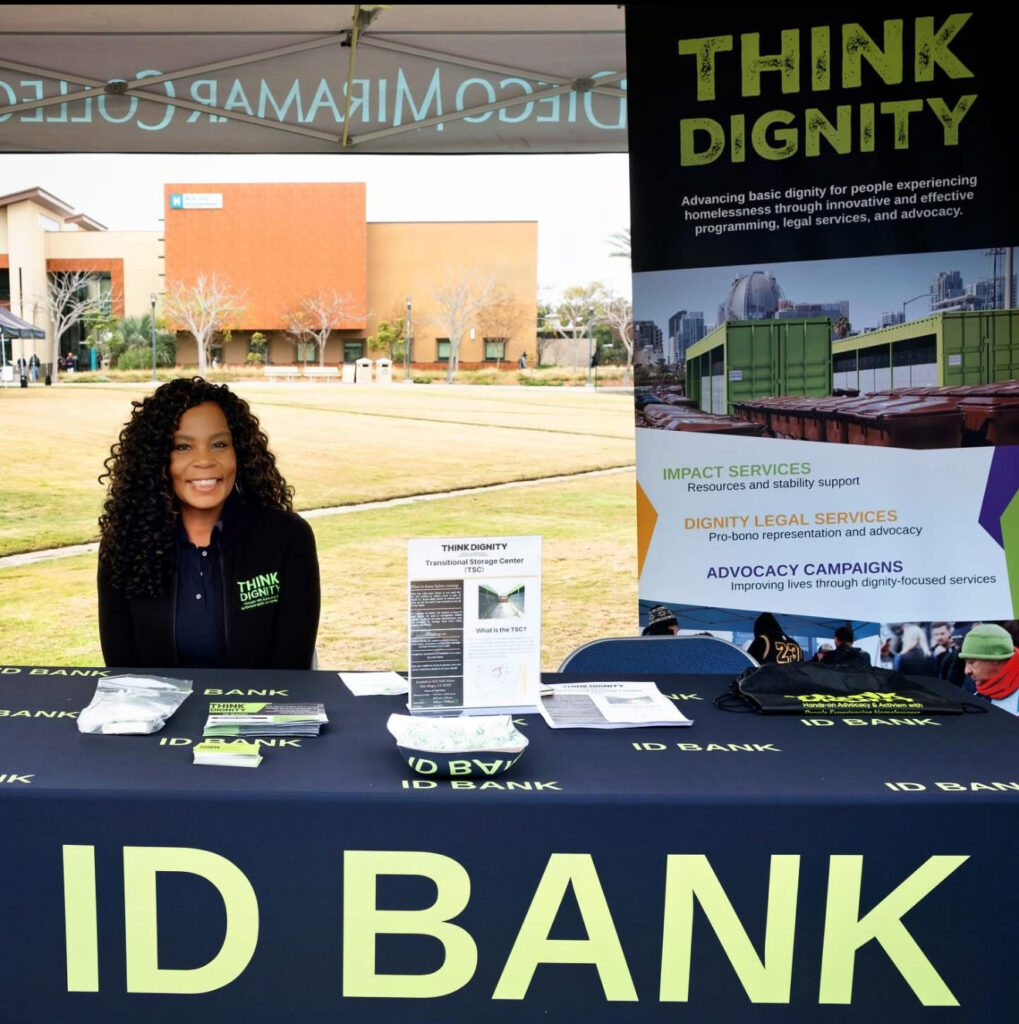
At one of the tables on many days during the project, a Think Dignity representative sat and worked with people from the encampment to help them find ID cards or other lost documents, and on some days groups of people were driven to a DMV.
It’s a service Think Dignity also provides at other locations as part of its ID Bank, which includes secure storage of vital documents and assistance in acquiring birth certificates, Social Security cards and California ID cards.
The ID Bank also provides copies and imaging, accessible electronic and paper documentation and assistance in completing application forms with all fees covered.
“IDs are the most critical,” Grady said, adding that most people at the encampment did not have theirs. “That’s the beginning of what folks need to get into housing.”
Think Dignity was formed in 2006 as Girls Think Tank by nine San Diego women who united to create a way to help homeless people in the city. The nonprofit expanded, evolved and changed its name but retained a focus on restoring basic dignity to unhoused people.
The nonprofit also operates a Street Boutique, mobile showers, storage facilities and provides other services. It recently introduced mobile phone-charging stations and launched a legal service in September at the Lemon Grove ERF project.
While at the site, Grady said she met with some of the people living in encampments and helped them tear down tents to prepare to move into housing, which she said was an emotional experience.
“It was just a phenomenal feeling,” she said. “I’m in the office doing reports and finances and organizing, and it’s really nice to be hands-on here, doing this project in Lemon Grove.”