

Sept. 14, 2026
Fourth in series of four.
Oceanside police officer Jason Dantzler knows the frustration of trying to convince homeless people to accept shelter and other help.
“A lot of the people we talk to don’t want services,” said Dantzler, a member of the Oceanside Police Department’s Homeless Outreach Team, or HOT.
Dantzler hears the same from enforcement officers who make contact with homeless people. He suspects there are a variety of reasons people turn down offers of help, including a sense that they will give up their freedom to live how they want.
There could be other reasons. In May 2026, the Oceanside City Council agreed to transition from a police-led HOT to a new, civilian-led Homeless Evaluation, Assistance & Response Team, or HEART.
While police-led outreach teams in Oceanside have successfully connected people to shelter and resources for years, Police Chief Taurino Valdovinos told council members at the May meeting that professionals trained in the field should take the lead.
Oceanside is not the only city to make such a change. The shift is intended, in part, to address the belief that homeless people are more likely to turn down offers of help from law enforcement officers than from civilians.
“It’s a new approach,” Dantzler said. “It’s going to be a great approach. Hopefully, everything works out. It’ll just be a change in who will be outreaching to people. But a lot of folks don’t want to come out to these areas without law enforcement being present.”
On this September day, the city had not yet made the transition or named a service provider to lead the team. Dantzler was leading a team of outreach workers from Interfaith Community Services.
Once the transition is complete, OPD will not be entirely out of the picture but will back up the new HEART workers when needed.

Makayla Hilliard of Interfaith Community Services and OPD Officer Jason Dantzler walk through an Oceanside hillside where they met with homeless people. Photo by Arash Tebbi.
As he spoke, Dantzler was walking up a trail north of State Route 76 and Oceanside Municipal Airport, followed by Interfaith outreach specialists.
“Hello, Antonio,” Dantzler called into an encampment. “How are you?”
Dantzler told Antonio he was looking for a man named Gregory. Antonio appeared jittery and nervous and said he was about to leave.
“You’re leaving already?” Dantzler said. “Bye, Antonio. Have a good day.”
Dantzler later said Antonio is known as “the Godfather” on the hilltop and has been a frustrating case.
“He’s one of the people that we have been trying to help for a very long time, and he’s not taken advantage of the help that we’ve offered,” he said.
It can take time, outreach workers agree.
“My experience has been that the greater success you’ll have with people comes from the rapport and the consistency,” said Arilene Kassicieh, program manager for Interfaith Community Services.
“When we think a lot about our population or the clients who have been chronically homeless for a long time, they’ve maybe felt disappointed by the system,” she said. “They’ve been let down, right? They’ve gone through a lot of services, so it’s like, ‘What am I going to do differently from everyone else?’”
Kassicieh said that, as an outreach worker, she would build relationships and trust with clients through consistent interactions. She said she hears from outreach workers in the field that they have success with that method, too.
“They’ll check in on people and ask, ‘How are you doing?’” she said. “At first, they’ll say, ‘I’m good. I don’t need anything.’ And a little while later, I’ll hear that they got them into the shelter or that they were open to substance treatment and things like that.”
Back on the Oceanside hillside, outreach worker Makayla Hilliard put that practice to work when she met Gregory, the man Dantzler was trying to find.
“What do you think about going to our shelter?” she asked Gregory, 63. “Just think about it.”
“OK,” he said.
Hilliard asked Gregory a series of questions about his past and learned that he had not been to the shelter in Oceanside because his girlfriend, who was with him, did not want to go.
“Before you became homeless, were you staying with somebody?” she asked.
“Before I was homeless?” he replied. “I was just starting to work and had my own apartment.”
“How long was that? How long were you staying in your apartment?”
“Around a year. I was married for like 30 years, got divorced, and had my own place.”
“And what day did you become homeless again?”
“I finished treatment Jan. 4, 2017. I’ve been homeless since 2017.”
“Are you using anything right now? Alcohol? Substances?”
“No alcohol. I smoke weed. And maybe do meth.”
While Gregory didn’t initially have the clearest answers, the line of questioning revealed that he had been homeless for nine years, had undergone treatment, and was still using drugs.
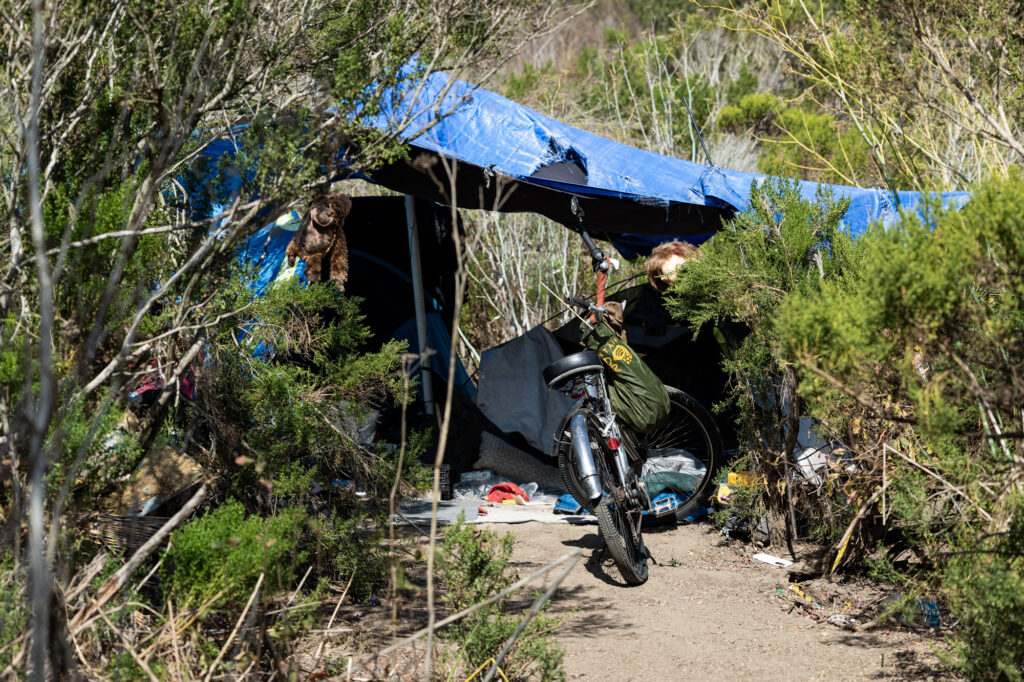
The Oceanside outreach team found several hidden encampments on a hillside north of state Route 76. Photo by Arash Tebbi.
Hilliard told Gregory about an upcoming detox event in Escondido, and he agreed to be put on a waiting list for the shelter in Oceanside. While this wasn’t a breakthrough, it was a step.
Kassicieh said outreach workers can play an important role as a conduit between a homeless person and a resource.
“They have clients who have gone through some hoops or played phone tag trying to access the right resource, and that might create a barrier,” she said.
Kassicieh also said it’s important to be available the moment a person decides to accept help. She recalled an incident involving a woman who had repeatedly turned down offers of services, until one day at a mobile shower event in Carlsbad.
“My outreach person saw she was drinking a wine cooler at 7 in the morning, and he just had a very honest conversation with her,” she said. “He was like, ‘I don’t want you to feel bad, but have you considered treatment?’ And something clicked in her, and she said, ‘Yes, I’d like treatment.’”
Kassicieh said the woman went into detox, stayed sober, was matched with rapid rehousing, and is doing well to this day.