
Sept. 9, 2026
Third in a series of four.
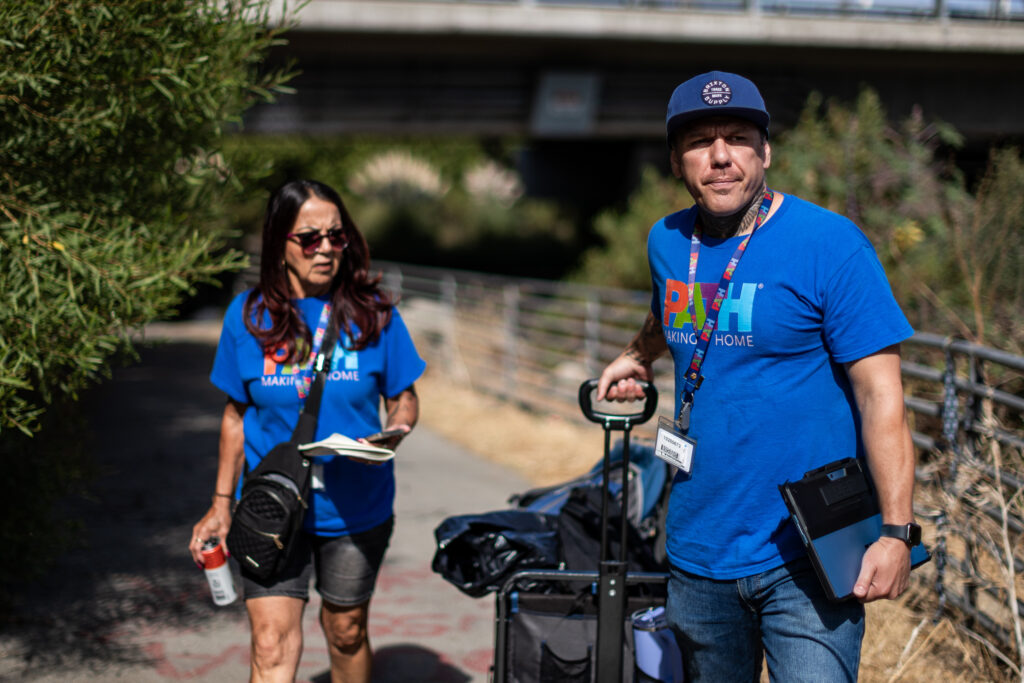
Cindy Smith and Michael Olmos, outreach workers with People Assisting the Homeless, turned down the path off Pacific Highway just north of Old Town and began walking toward the San Diego River.
A couple of cyclists passed. A jogger trotted by. It’s a nice walk on a warm summer day, and despite the roar of Interstate 5 and the rumble from the trolley tracks overhead, it’s a place where San Diegans might feel a connection with nature just a few miles from downtown.
For more than a dozen people on this day, it’s also a place to call home.
“Five years,” April said when asked how long she had been homeless.
She didn’t mean she had been living in that specific encampment for five years. She elaborated that she had lived in many places across the country and even in Europe for two years.
“I’m cultured,” she joked.
April would be moving along again soon. A paper reading “Notice to Vacate Campsite” was taped to a nearby tree, with a warning that all people and personal items had to be off the property within a couple of days, and failure to comply could mean arrest.
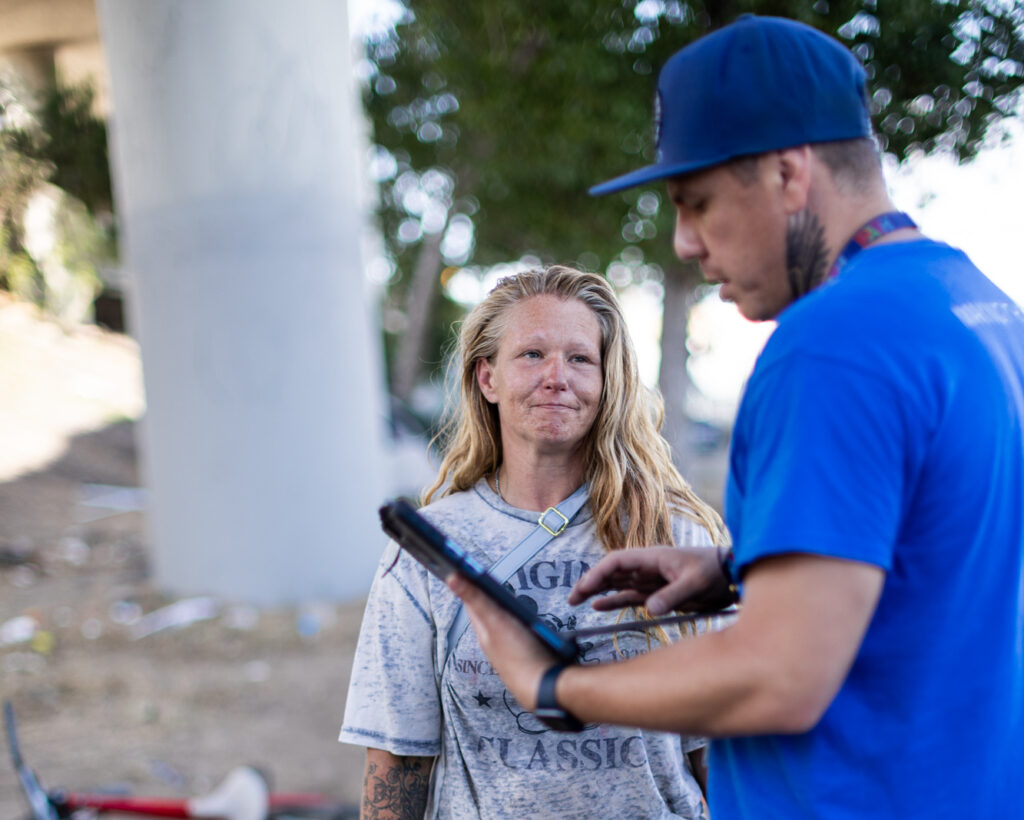
Michael Olmos of PATH gets information from April, who was living in an encampment near the San Diego River. Photo by Arash Tebbi.
Olmos said such clearings happen periodically. April and the others didn’t seem in a rush to leave, but she did say she wanted a way out of her situation.
“Just a way to be off the street,” she said when asked what she was looking for. “Just getting off the street helps people, because it’s a lot to deal with out here.”
April said it is not true that people in encampments do not want help, but what they need isn’t something that’s often offered.
“If I had housing, I could do so much more, like start back on my career,” she said. “I like to draw. I’m like a starving artist. I like to paint and make stuff, like jewelry. I can’t take any of that out here because the moment I do, it gets taken, so there I am back at square one again. You know what I’m saying? There’s nowhere safe.”
While Olmos and Smith were conducting outreach in the field that day, on other days they work with PATH clients throughout the county who have called 211 for assistance.
Some are in housing but still need help, illustrating the wide spectrum of homelessness.
“I think for the majority, a lot of people are not on drugs,” Olmos said, addressing a typical stereotype of a homeless person.
“We have a lot of people with mental health issues,” he continued. “We have a lot of families that have succumbed to the pressures of inflation, not being able to pay rent. Domestic violence situations or veterans trying to combat PTSD. We have a lot of situations here. I don’t think that a lot of our clients are specifically on drugs, but there are some who are.”
“I had a call this morning from a lady who had six years clean,” Smith said. “But she’s homeless.”
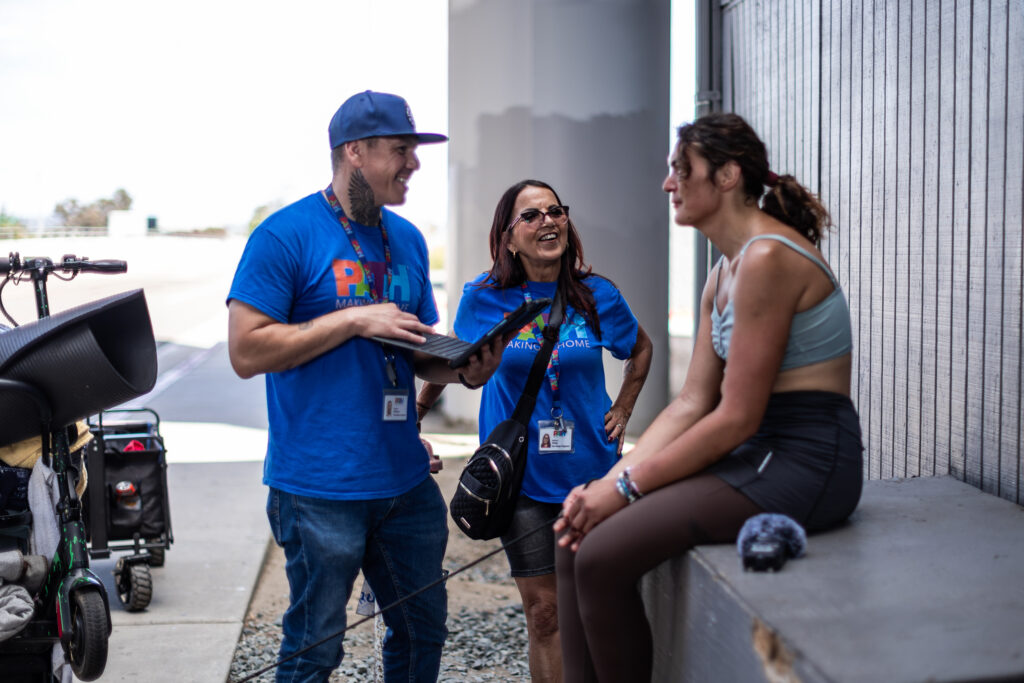
Michael Olmos and Cindy Smith of PATH get information from Christy, a homeless person they met near Old Town. Photo by Arash Tebbi.
Besides April, the two outreach workers talked with several people at the encampment, connecting them to resources that could lead to long-term help, as well as offering hygiene kits, trash bags, socks, water and other items to help them get through the day.
Back on the sidewalk, as they returned to their car, they ran into Christy and her dog, Becky. Christy was pulling a cart loaded with her electric scooter and other possessions.
A trans woman, Christy said family issues led to her becoming homeless about two years ago. When asked if she had been to the San Diego LGBT Community Center, she said she had not.
“I’ve been meaning to go there,” she said. “I’ve honestly had no excuse for not having been there yet.”
“They have more services to offer you,” Smith said.
“I really should go there,” Christy conceded.
Christy grew more comfortable talking with Smith and opened up about needing help getting her prescriptions for hormones because her benefits were tied up in red tape.
“They want documents and asked to see the last 30 days of my account, and that was months ago,” she said, adding that she had been unable to access her account since she had no computer.
Smith suggested Christy use computers and printers at a public library, and she took Christy’s number to connect her with a case manager.
Christy said she has trouble getting places sometimes because she can’t charge her scooter, and she was excited to hear her case manager could drive her to appointments.
“Wow, that’s pretty cool,” she said.
“We’re going to come back and see how you’re doing and check with everybody else here in a week or so,” Olmos said.
Christy thanked them and later reflected on the perception that homeless people do not want help.
“It’s not that,” she said. “It’s just that people get tired of being typecast just because you’re homeless. They think people are on drugs and addicted, and people on drugs and with addictions don’t want help. But everyone needs resources for things they have to deal with health-wise and mental-health-wise. Everybody could use something.”