
Nov. 3, 2026
A Monday night presentation on the proposed redevelopment of the Community Resource Center in Encinitas became contentious at times as some residents said the project should not be allowed and the center should move to another location.
Others at the Nov. 2 meeting of the Citizen Participation Plan Board said the CRC performs a needed service in the city and the redevelopment would improve the aesthetics of the neighborhood.
The redevelopment plan has been controversial, and more than 1,000 signatures have been collected on an online petition opposing the expansion of the CRC because of what petition organizers call “public safety and health risks.”
At the meeting, Community Resource Center CEO John Van Cleef stressed that the proposal is not an expansion but rather an upgrade and improvement to programs and services already at the site.
Van Cleef was joined at the meeting by Marco Gonzalez, the CRC’s pro bono land-use counsel and a partner with Coast Law Group.
Gonzalez instructed the overflow crowd that the purpose of Citizen Participation Plan Board meetings, a requirement even for ministerial projects, was to inform the community about what he called the nuts-and-bolts details of projects, such as their density, effects on traffic, drainage and aesthetics.
The CRC recently submitted its third round of plans, and community input from the meeting could be used to mitigate issues in the project design, he said.
“I really want to encourage people to tell us whatever you want and to ask us questions about the project,” he said, adding that there are things they are not there to discuss.
“We’re not here to talk about whether the CRC should provide food assistance to people in need,” he said. “We’re not here to talk about whether food distribution or supportive services attract unsheltered folks. We’re not here to talk about whether assistance encourages dependency or who the CRC serves, where clients come from and how eligibility is determined. All of that will stay the same as what’s there now.”
That suggestion fell on deaf ears for some in the audience, including a woman who said her medical clinic on Second Street could go out of business because homeless people are scaring her clients away.
Another person raised his voice and yelled at someone else to shut up, and others said CRC was attracting homeless people who were disruptive to the neighborhood. Some people were supportive of CRC’s mission but said it had outgrown its location and should move to a larger building away from downtown Encinitas.
While there were some heated moments, much of the meeting indeed was focused on the nuts and bolts of the construction project and the planning process.
Van Cleef gave background on CRC, which was founded in Encinitas in 1979 and has been at the same site since 1984, where it operates a food pantry and provides services for stable housing, homelessness prevention, domestic violence survivors, counseling and behavioral health. CRC helps more than 8,000 people each year, and the majority of its clients are not homeless, he said.
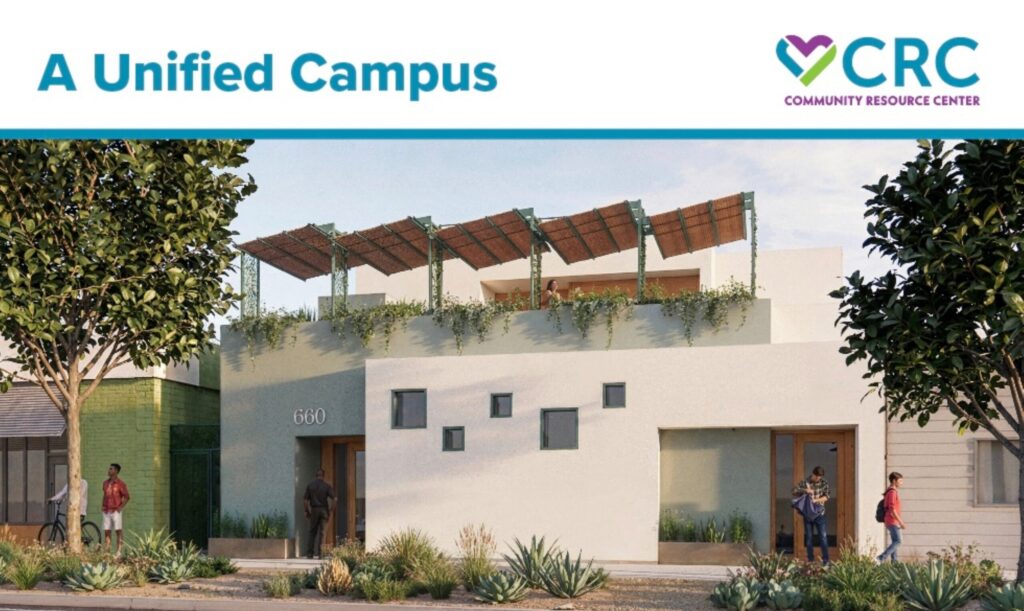
The center’s offices and food pantry are at 650 2nd St., and in 2021 the nonprofit purchased the property next door at 660 2nd St. for the pantry’s new home. A capital campaign has raised $10.7 million toward a goal of $14.1 million to demolish and replace the existing buildings.
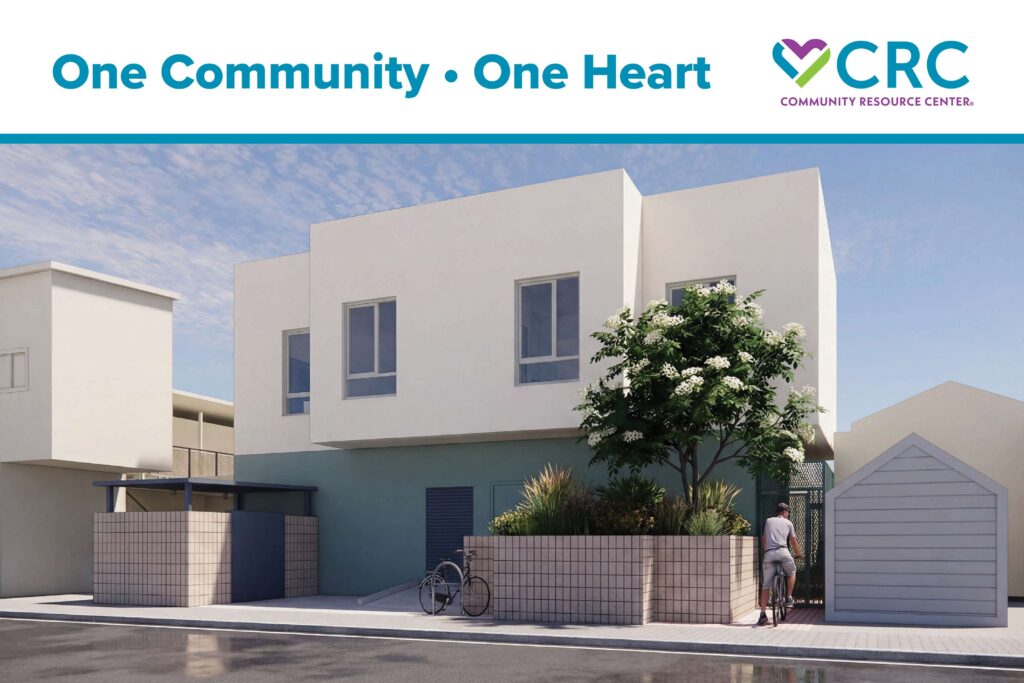
An artist rendering of a proposed five-unit residential building planned by the Community Resource Center.
The CRC’s food and nutrition program will relocate to 660 Second, and five residential units now on the property will be replaced with five deed-restricted apartments for low-income residents under the plan.
“The CRC Market, whose clients are mostly Encinitas residents, will provide a more functional, welcoming and efficient space for food and nutrition services that CRC already provides on Second Street,” Van Cleef said. “The project does not increase the number of residential units, and the CRC Market is not an expansion or intensification of CRC services.
“We are not proposing new CRC programs,” he said. “We are creating a better physical environment for existing uses of the property and for work that already takes place on Second Street. Put simply, the building is new, CRC’s presence and purpose is not.”
Van Cleef said improvements will include a new indoor waiting space and accessible bathrooms for CRC clients.
“We value being a part of downtown Encinitas, and we take seriously our responsibility as a service organization and property owner,” he said. “This project is an investment in that responsibility, an opportunity to make better use of our own property, create a facility that better serves its purpose and contribute positively to the character of downtown Encinitas.”
Gonzalez said the CRC and city officials disagree about whether the project needs to go before the Planning Commission. He argued the project already complies with local zoning codes and state housing and land-use laws, so the Planning Commission could not put additional conditions on it.
“They (Van Cleef and CRC officials) will always try to do what they can within the scope of their mission to address the impacts that the community has,” Gonzalez said. “However, what we’re not going to subject ourselves to is the circus.”
By “circus,” Gonzalez said he meant the hostility the project has faced in the city from people who do not want homeless services in their community, which he said would continue if it were to go before the Planning Commission.
“I get that, but they’re going to be here,” he said about CRC.
Gonzalez downplayed the impact of the renovation, which he called “a tiny project in the grand scheme of things.”
The plan calls for the demolition of a 2,325-square-foot “hodgepodge of buildings,” he said, and the construction of a new 6,950-square-foot mixed-use project that will include 4,594 square feet for offices and the CRC Market.
About 2,000 square feet will be for five residential units affordable for people who earn 30% to 50% of the area median income, he said.
The end result will be a more efficient center that serves the community and a modernized building that will enhance the area and match the historic look of the street, he said.
“I think one of the things that’s important is for people to realize what we’re trying to bring to the neighborhood,” he said. “I think there is pride in the neighborhood when new structures come in and they’re built with an eye toward the modern, and an eye toward the past as well.”