
A large homeless encampment in Lemon Grove had been a sore spot in the city for years. Past efforts to clear it had been unsuccessful, and residents and business owners were growing impatient with city officials.
Then in August 2025, a team of service providers and homeless practitioners moved in, backed with an $8.4 million grant from the state’s Encampment Resolution Fund. The goal was to provide housing over two years for 102 people and provide services for 170 people in all.
Crews from the city of Lemon Grove, Impact Group, Crisis House, Brilliant Corners and RTFH (Regional Task Force on Homelessness), the lead applicant for the state grant, worked together over five weeks to completely clear the encampment and find homes and wraparound services for about 30 people.
These are the stories of how it happened, who was helped, and the businesses, residents and city officials cheering on the change.
Lemon Grove ERF 7: Street medical teams
Life in a homeless encampment is not healthy for people or pets, but both can receive help from street teams of doctors and veterinarians.
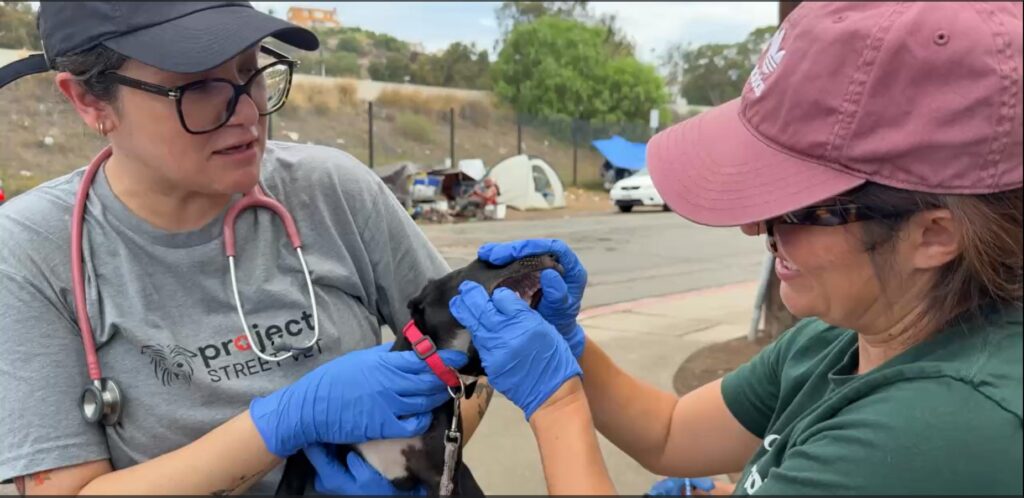
In September, members of Family Health Centers of San Diego and Project Street Vet visited the large homeless encampment in Lemon Grove where a team of service providers and homeless practitioners had been working for weeks to clear the street and find homes for about 30 people.
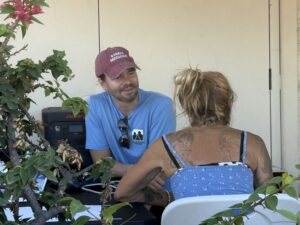
Dr. Greg Weygandt of Family Health Center talks with a homeless woman during the Lemon Grove Encampment Resolution Fund project. . Photo by Gary Warth.
Dr. Greg Weygandt of Family Health Centers of San Diego said he was excited about the invitation to join the team at the encampment.
“It’s been a little different than our normal process because we’re working with that team rather than being on our own, which is nice because there’s already been a relationship built with this community,” said Weygandt, who was at the site three times in September.
“They already know people, and they say, ‘Oh, we now have another service provider to talk to,’ and so that really helps us to have a foot in the door with a lot of folks,” he said.
Having an ice-breaker relieved some of the uncertainty that usually comes when visiting an encampment for the first time, Weygandt added.
“If it’s a new encampment, it’s usually, ‘What are you doing here? What do you want from me? Am I being kicked out?'” he said. “It takes a little time to explain to them what we can offer. And even after that, sometimes it can take a few visits to that same spot to build enough trust for somebody to engage in care and actually want to do a visit with me.”
On this particular day, the few patients Weygandt saw did not have serious medical conditions, but he said he was glad to make a connection with them.
When asked about the type of conditions he commonly sees in an encampment, he replied, “Everything.”
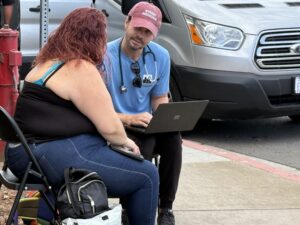
Dr. Greg Weygandt takes notes while discussing health conditions of a woman who was living in a Lemon Grove encampment. Photo by Gary Warth.
“The things that people have engaged with us the most about are acute issues,” he said. “They can be wound care if they have an injury or a specific ache or pain. They’ll say, ‘OK, maybe I’ll see a doctor.’ But then after we kind of break that seal, we get into more primary care.”
Weygandt said the most prevalent issue he has seen at the Lemon Grove encampment is addiction.
“People use (drugs) for a lot of different reasons,” he said. “Some people are using for survival. People have to stay awake to protect their belongings or not get sexually assaulted. Some people have had other longstanding addictions, so it’s pretty variable. But it’s very, very prevalent.”
Bug bites are a common complaint from people in encampments, but Weygandt said the claim is a red flag for street teams.
“When we hear about spider bites, we’re like, oh, better check for MRSA,” (Methicillin-resistant Staphylococcus aureus, an infection caused by a staph bacteria.)
After treating people on the street for any acute health issues, Weygandt said his goal is to get people into long-term care.
“We mostly have been connecting them to clinics, so I’ll do an established care visit,” he said about meeting people at the Lemon Grove encampment. “I would say, these are things that a doctor can do for you, because a lot of people haven’t been to a doctor in years. So I will address any acute concerns, and then I’ll send a message to their nearest clinic.”
On another day in September, veterinarians Karina
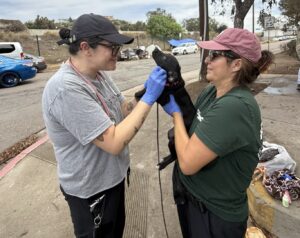
Karina Banuelos and Vanessa Garcia with puppy Monse. Photo by Gary Warth
s and Vanessa Garcia from Project Street Vet visited the encampment to tend to people’s pets.
“We provide vaccines, basic preventative care,” Banuelos said. “We’ll treat smaller issues, like superficial infections or bug bites or flea bites. That’s very common right now.”
For issues that require x-rays or blood work, the veterinarians can refer them to hospitals that are partners with Project Street Vet, she said.
Garcia said she has done outreach in many encampments and has gotten to know social workers who have circulated her phone number so people can call her with urgent needs.
She said encampment residents themselves have come to know her and have told other people about Project Street Vet.
“The unhoused population has their own communities,” she said. “It’s almost like networking. People have gotten our numbers and they know who to call in certain situations.”
Both vets said the pets they treat in encampments are usually in good shape.
“The biggest thing I see are flea allergies where they come in with skin issues, but overall they’re very well fed,” Banuelos said. “Mostly the dogs are very, very receptive to being treated and getting vaccines.”
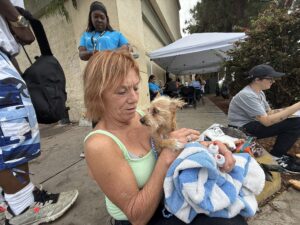
Mary Ellen Quandt and her terrier Sunny were living in a Lemon Grove encampment when the Project Street Vet team visited. Photo by Gary Warth
Karey Brintle, 74, lives out of her car and brought her husky-mix Luna to the encampment station to meet the vets.
“They checked her because sometimes she throws up and I get really worried,” she said about Luna. “They gave me something for fleas and a de-wormer, and they’re going to have me come back because she has problems with her teeth.”
Jennifer Carnes brought her puppy Monse to be checked because she had a cough.
“Her nose was starting to run and I thought it was a cold, but it could be kennel cough,” she said.
Banuelos assured Carnes that Monse would be OK with antibiotics, but at 9 weeks old she was too young to get all her needed vaccines. The two vets held the squirming puppy and couldn’t help but laugh as Monse tried to lick them while they checked her teeth.
Mary Ellen Quandt lives in her car with her little terrier, Sunny, who was too skittish for the vets to check.
But there would be another day for that, they told her. Project Street Vet makes regular stops at resource fairs, and Quandt and Carnes were told they would meet up with them again for follow-up visits.