
A large homeless encampment in Lemon Grove had been a sore spot in the city for years. Past efforts to clear it had been unsuccessful, and residents and business owners were growing impatient with city officials.
Then in August 2025, a team of service providers and homeless practitioners moved in, backed with an $8.4 million grant from the state’s Encampment Resolution Fund. The goal was to provide housing over two years for 102 people and provide services for 170 people in all.
Crews from the city of Lemon Grove, Impact Group, Crisis House, Brilliant Corners and RTFH (Regional Task Force on Homelessness), the lead applicant for the state grant, worked together over five weeks to completely clear the encampment and find homes and wraparound services for about 30 people.
These are the stories of how it happened, who was helped, and the businesses, residents and city officials cheering on the change.
Lemon Grove ERF 8: The Housed
Three men share their story from the street to a home
The three men living on the second floor of a converted motel in the Midway District had been neighbors before. But now, they were separated by walls, not thin tents. They had their own bathrooms, a door with a lock and an actual bed instead of asphalt.
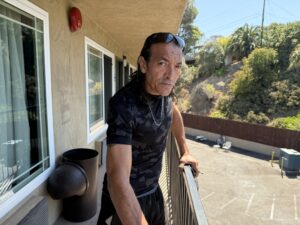
Elliott Bender on the balcony outside his apartment shortly after moving out of a Lemon Grove encampment. Photo by Gary Warth
Elliott Bender, Cardell Turner and Ridge Davis lived in an encampment on North Avenue in Lemon Grove until early September. They each remember an outreach worker from Crisis House approaching them with an offer of housing, and all three were skeptical until the day they moved in.
Generalizations often are made about homeless people, but each had their own experience, their own downward journey, and their own story. Some had endured generational poverty, and others crashed with a single life-altering event.
Elliott’s story.
“My father became quite ill and was essentially aging out, so I wanted to be here before his transition,” Bender, 61, said about why he came to San Diego seven years ago.
There was no inheritance after his father’s passing, and Bender had nothing to fall back on. He became homeless three years ago in Lemon Grove, a city he still was unfamiliar with. He began sleeping outdoors.
He had faced similar challenges before, including a stint of homelessness in San Francisco that turned him off shelters for good. He also had been incarcerated, battled mental health issues and survived a motorcycle accident that left him with serious back injuries that required surgery.
“My days were pretty filled just with survival, having to figure out what I could eat, where I was going to stay that night,” he said. “Was it going to be safe? Are cops going to come? Is Caltrans going to come and throw away all my stuff? That’s always an incredibly stressful guessing game to play every day. It’s pretty much a full-time job in and of itself.”
Bender was grateful for any help he could get, and particularly remembers a woman named Teresa from the Lucky Duck Foundation who boosted his morale and gave him a coat that converts into a sleeping bag to help him survive brutally cold nights.
“It would feel pretty hopeless sometimes,” he said. “The most difficult part was keeping morale up and believing, having faith maybe, that this too would pass, that I would become well, that I would be housed before I lost the rest of my sanity.”
He also is grateful for help he received from an outreach team from People Assisting the Homeless and others from Crisis House. Finally, he was both grateful and surprised by Brilliant Corners, who said he could be housed and even showed him three places before he settled on his new home.
With his life stabilized, Bender said he is on a self-improvement path and staying positive.
“I am in the process of seeking out psychiatric help again and getting back on depression meds,” he said, adding that he also is joining a 12-step group.
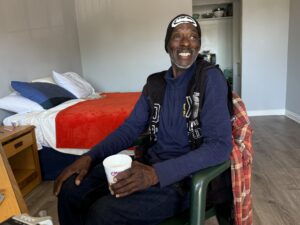
Cardell Turner once worked as a vocational nurse, but also experienced homelessness and addiction. Photo by Gary Warth
Cardell’s story
Cardell Turner’s life could be a tragic screenplay, but also a story of redemption.
The once-promising youth who excelled in science classes and became a licensed vocational nurse also spent years in prison for selling drugs and had been homeless off-and-on for many years, including the past eight.
“But the past five years, I’d say, have been the most struggling,” Turner, 64, said about his time on North Avenue in Lemon Grove.
Turner was born in Oklahoma City one of eight children, and he spent his childhood years on the family farm.
His father took a job in San Diego working on the construction crew building the Coronado Bridge, and was killed by a drunk driver in the city.
The tragedy was devastating for the family and almost tore them apart, but Turner said his mom pulled herself together and loaded him and his siblings into her green station wagon and headed to San Diego, where his late father had friends and colleagues.
Turner did well in school, and he still remembers the teacher who inspired him.
“There was a science fair at the school, and they had all this stuff on the playground that I was so interested in,” he said, recalling a teacher named Dr. Watts and a volcano model that fascinated him.
Turner graduated high school and went on to college and became a licensed vocational nurse, but he also was living a double life. He had become homeless while in school and continued to live on the street to save money even after getting a job.
While living on the street, he said he met someone who paid him to deliver bags to people. “I was like what they’d call a square,” Turner said about his naivete at the time.
He moved in with a girlfriend and the two lived together a while, but he said he moved out after discovering she was an addict. Back on the street, he met up again with the person who had paid him to deliver bags. This time the curiosity got the best of him and he finally looked inside and discovered it was crack cocaine.
Missing his girlfriend, he began using the drug himself. He continued his side hustle until the day he discovered one of his best customers was an undercover detective, and he was busted.
“All of my misfortunes were my fault,” he acknowledged.
But his life was to take more twists. Turner said he was advised to plead guilty because he had no past offenses, but a review of his record before his sentencing mixed up his name with someone with the same name who had two homicides on his record.
“I said, ‘What? I never killed anybody,” he said. But having already pleaded guilty, Turner said he was sentenced to 51 years in prison.
His life took another bizarre turn after serving nine years. Turner said there was a riot in prison and a correction’s office was stabbed, and he pulled her inside his cell and shut the door to protect her. The officer later successfully argued for him to be released.
Turner was released, but was homeless again. After trying for 10 years, he finally got a pardon that allowed him to take the state test again to get his license back. He returned to work, but his life spiraled again when one of his brothers was killed.
He began missing work to take care of his mother – Turner said he doesn’t know how many days he was out – and his boss from the hospital showed up to check on him.
“She said she was going to get some help for me, that I needed to see a psychiatrist,” he said.
Turner was out of work again, and more tragedies were to come. His sister was killed in her apartment, and then another brother was killed. Two of his sisters then got ill and died.
The trauma led Turner back to drugs, but he said he has been sober for the past two years. He said he and other people were skeptical when someone from Crisis House approached them with offers of housing, but they started to believe them when they were taken in a caravan to view places.
“They were doing what they were saying,” he said. “They were helping with paperwork. When we were in the van, they’d say, ‘Do you want to go get your ID?’ And when they get all these things straightened out for you, it can change your life,” he said.
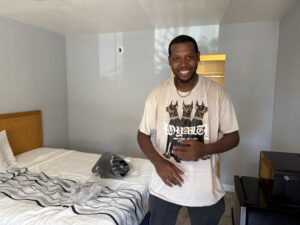
Ridge Davis moved to Lemon Grove in 2022 to be with his mother, but became homeless two years later. Photo by Gary Warth
Ridge’s story
At 32, Ridge Davis was younger than many of the people who had been living on North Avenue, but had experienced homelessness off and on over several years.
“But I’ve never been, like, ‘homeless’ homeless before,” he said as he unpacked his things while moving into his new apartment. “I always had somewhere to go. Like, at the end of the day, I had a choice to be inside or outside.”
Things changed after he moved from Florida to Lemon Grove in 2022.
“My mom, before she passed away, that’s what got me out here,” he said. “She wanted me to come out here and be with her. She really wanted all the kids out here.”
His mother passed away in 2023. Davis said he had a girlfriend who could help, but she lost her home.
“She’s going through some on-and-off problems, too,” he said.
Davis became homeless in 2024, alongside his brother and a cousin.
“It was all right for temporary, until someone reaches out to us and helps us out,” he said. “And then it’s up to us.”
Waiting for that someone to reach out, however, could be confusing and frustrating.
Davis remembers a woman named Kristy who offered help, but she seemed to be acting on her own and not associated with any group.
“She ended up disappearing,” he said.
Davis admits that there was a time in his life that he would have been defiant and not open to any help.
“Back then, the old me, I would have turned them down,” he said. “I was like a hot head. Now, I’m chilling. I changed my life, man. I’m done going through that for too many years.”
When Davis heard there was a group offering housing, there was some initial confusion. He said someone told him the offer actually was for a shelter, which he said he would have turned down.
But then he met Crisis House outreach worker Vani Melei, whom everyone knows as “V.”
“V told me, ‘Come over here and sign these papers, and I’ll get you a room,” he recalled. “That V, he’s good.”
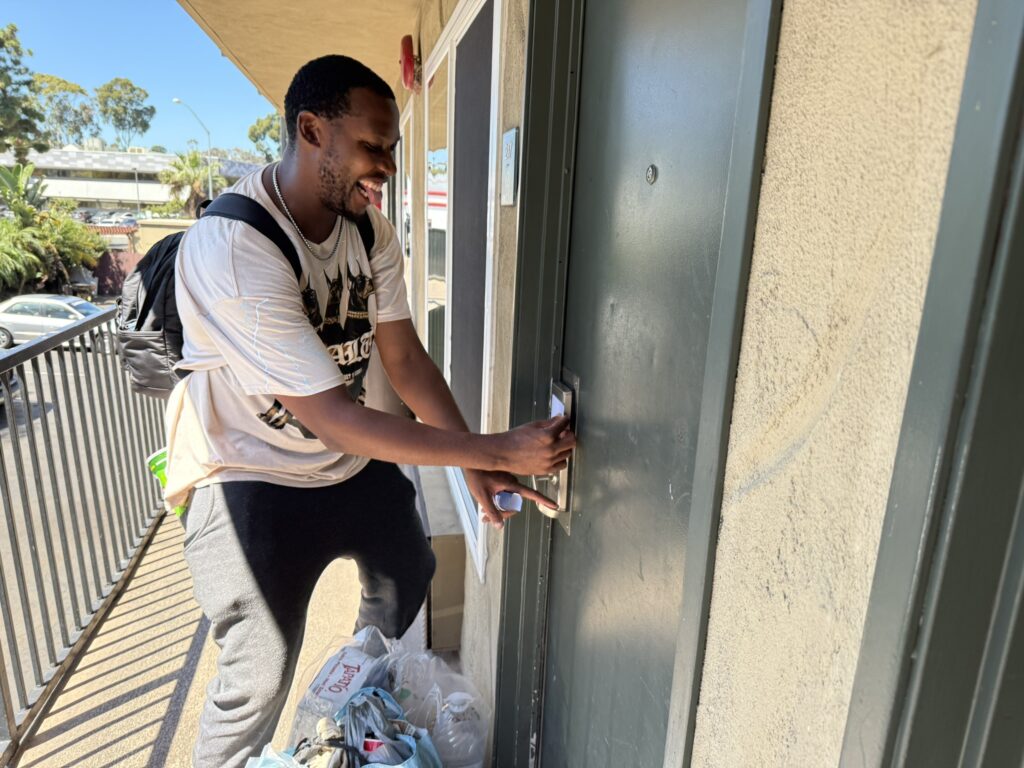
Days after first seeing the apartment in the Midway District, Melei drove Davis and his belongings back to the building and helped him move in. Davis said his cousin also would be moving in, and he was trying to get his brother a room, too.
“Right now, I’m pushing for a job,” he said, adding that something already is in the works. “I’m trying to get another moving job. That’s what I do. I liked to work. I used to work for a moving company and used to work for a lawn business. If I can find something like that, I’m in. I’m back.
“And now I’ve got, what do you call it? A support system to help me out.”