
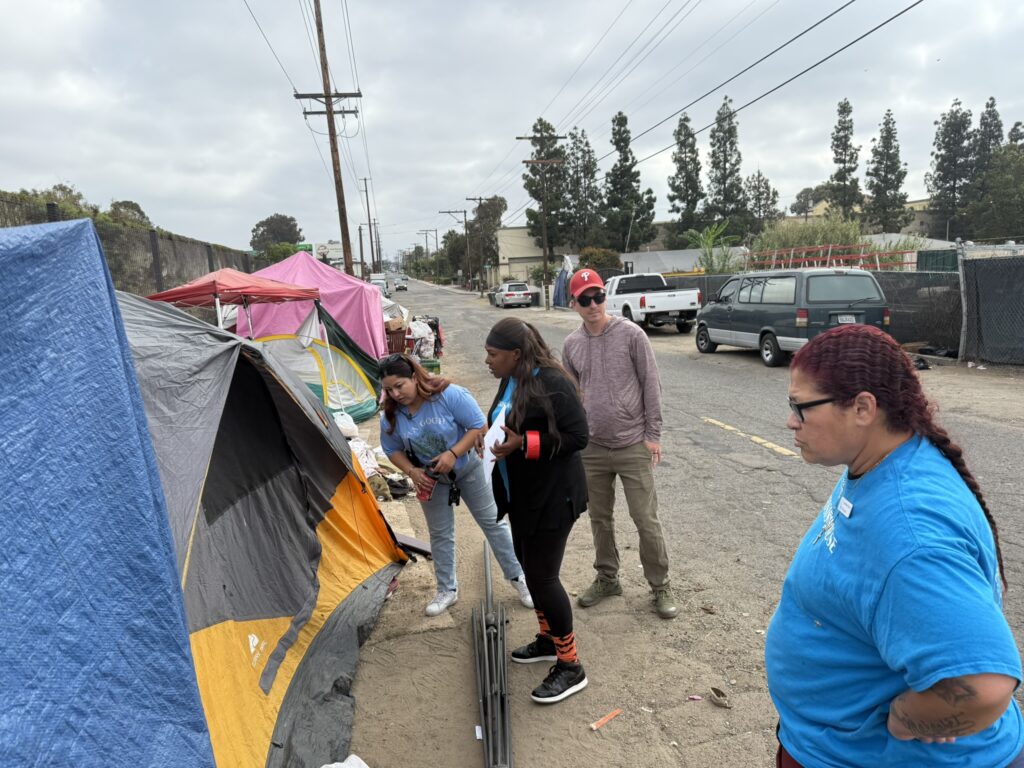
A large homeless encampment in Lemon Grove had been a sore spot in the city for years. Past efforts to clear it had been unsuccessful, and residents and business owners were growing impatient with city officials.
Then in August 2025, a team of service providers and homeless practitioners moved in, backed with an $8.4 million grant from the state’s Encampment Resolution Fund. The goal was to provide housing over two years for 102 people and provide services for 170 people in all.
Crews from the city of Lemon Grove, Impact Group, Crisis House, Brilliant Corners and RTFH (Regional Task Force on Homelessness), the lead applicant for the state grant, worked together over five weeks to completely clear the encampment and find homes and wraparound services for about 30 people.
These are the stories of how it happened, who was helped, and the businesses, residents and city officials cheering on the change.
Lemon Grove ERF 9: What comes next
Oct. 8, 2025
Daniel Sturman, encampment initiative program manager for the Regional Task Force on Homeless, walked up North Avenue in Lemon Grove the morning of Oct. 8, a stack of papers and a roll of tape in his hand.
“We started over here by the Food 4 Less parking lot,” he said. “We had one vehicle in the parking lot that we identified as part of our by-name list, and then we had a tent that was between the Home Depot and Food 4 Less. Those people have been housed already.”
Sturman, the encampment initiative program manager for RTFH (Regional Task Force on Homelessness) oversaw a project on North Avenue to collect information from people living in the encampment and move them into subsidized housing for the next two years.
Crews were first on the site Aug. 18 to create a by-name list of people living on the site. Members of the nonprofit Crisis House began driving encampments residents to view apartments on Sept. 3, and people began moving into new homes two days later. Five weeks after the first move-in, there were just two people from the 32-name list left on the site.
The street was not clear of tents and debris, however. More people and tents sometimes would appear overnight, but the crew working on North Avenue had to have a cut-off point at some point. They may help in the future, however, as the state grant funding the project had a goal of housing 102people and providing services for 170.
For now, however, the new arrivals would have to move on.
Pausing for a moment, Sturman taped a notice to the tall metal fence that runs down North Avenue to protect Caltrans property near state Route 94.
“This encampment site will be closed on Oct. 15, 2025 @ 9 a.m. and sleeping will not be allowed,” the notice read. “All belongings must be removed by this time.”
Besides new people and tents, other large items have been appearing on North Avenue, which Sturman said has become a kind of dumping ground.
“These things keep showing up,” he said, pointing out a sink on the side of the road. “There’s a new mini-fridge over there I saw just now. This car seat over here and that love seat, that’s new this week.”
Besides the new notices, Sturman and Crisis House outreach worker Lawanda Sullivan also gave personal reminders about the closing date to the newcomers.
“I want to make sure that we’re able to engage these folks and really ask them, ‘Hey, where are you going, what do you have planned,?’” Sturman said.

Lawanda Sullivan of Crisis House places a sign announcing enforcement against encampments will soon begin. Photo by Gary Warth
Sullivan approached a tent and introduced herself to someone inside.
“Hi, good morning,” she said. “Homeless outreach. How are you? I just want to remind you that starting next Tuesday, these sites will be cleared. So you guys have to be out in this area by next Tuesday, and there will be law enforcement here.”
With one week left to go before the official closing date, Sullivan was still working on the remaining two people on the by-name list.
“Those are the tough nuts to crack,” she said about Jorge and Jennifer.
Jorge had been uncooperative since early encounters with him. Jennifer also has been difficult, but Sullivan believed she was making headway.
“What we’re basically doing with Jennifer is building rapport with her,” Sullivan said. “We checked on her yesterday, and we went and got her lunch and french fries. I’m trying to get her into the vehicle so she can get comfortable traveling with me so we can go look at units.”
Kris Freed of the Impact Group was often at the Lemon Grove site and said she also would continue to work with Jennifer.
“Just because the site is closed doesn’t mean we’ll forget about her,” she said.
If Jennifer does accept housing, she will have opportunities to be connected to other services that can help with whatever issues she may be experiencing.

Crisis House ERF Specialist Dushant Robinson at his station in Lemon Grove. Photo by Gary Warth
Dushant Robinson, an Encampment Resolution Fund specialist with Crisis House, is a case manager for 14 people from the site who have been housed.
“You have an outreach case manager, for lack of a better term, and then we have the stabilization case manager, which is me,” he said. “Once they become housed, then I take over.”
Robinson said his clients have a range of needs, some more serious than others.
“I’m just starting my assessment, and that starts with basically reiterating the rules and regulations of the program,” he said. “What their rights and responsibilities are, and what our expectations are of them, and what their expectations should be of us.
“Once you establish that, then you address any needs that may have so that you can build a plan towards self-sufficiency. That’s the end game, right?”
Some of the people have been chronically homeless for more than 10 years, he said, and many have been using drugs.
Drug use, however, is not necessarily the same as drug addiction, Robinson noted. He estimates about half have addictions, but not all of them will require clinical rehabilitation.
Crisis House also can help people find employment, provide transportation or even get them new clothing.
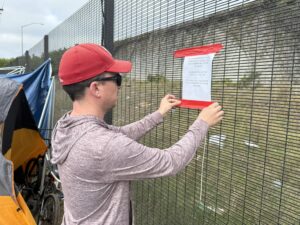
Daniel Sturman of RTFH led the outreach team in Lemon Grove. Photo by Gary Warth
“We can connect them to resources,” Robinson said. “Sometimes we get clothes donated to us and they’re allowed to go through what we have. Sometimes we’ll bring clothes to them, or if it’s an immediate need we’ll take them shopping.”
Robinson said the assistance he’ll provide will decrease over time as his clients become more self-sufficient, but he’ll still be there for them.
“We will always remain a resource,” he said. “They can always contact us if they have any questions or any hurdles or obstacles that they have along the way.”