
Feb. 13, 2026
State Sen. Catherine Blakespear is seeking to make it easier to house or shelter people experiencing homelessness, clear encampments near freeways and help cities expand low-income housing through several bills she has introduced or co-authored.
“This is early in the process,” said the Democratic senator from Encinitas, where she previously served as mayor. “These efforts probably won’t all make it to the finish line, but to move the conversation forward, you have to put a stake in the ground.”
Blakespear recently introduced Senate Bill 967, aimed at encouraging development of low-income housing.
The bill would allow cities to receive credit in their Regional Housing Needs Assessment (RHNA) process for building or zoning interim housing. Currently, cities receive credit only for permanent housing.
RHNA is a state-mandated planning requirement that sets housing targets across income levels. Jurisdictions that fail to meet those targets can face fines, lawsuits and the loss of infrastructure funding.
SB 967 would expand the definition of a housing unit to include interim housing.
“In interim housing, people can live up to two years, and in an apartment in California, people live an average of three years,” Blakespear said. “This is an arbitrary distinction in the law that needs to be changed.”
The bill was introduced Feb. 3 and referred to the Senate Housing Committee.
Another measure, Senate Bill 569, was introduced in February 2025 and passed the Senate floor 38-0 in June. It was referred to the Assembly, though its Transportation Committee hearing was delayed.
SB 569 would require the Department of Transportation to designate a liaison to work with local governments on addressing homeless encampments along state highways and Caltrans rights of way.
“That’s important because people are living on Caltrans property — on onramps and offramps,” Blakespear said. “If there’s any place that’s not a safe living environment, it’s a freeway ramp.”
San Diego already partners with Caltrans and local service providers to move people into housing and services. The city has a memorandum of understanding with the state and receives $400,000 for that work.
“The bill would require Caltrans to engage in a local process instead of saying, ‘This isn’t our problem,’” Blakespear said, noting that San Diego’s approach has become a model for other jurisdictions.
She acknowledged potential resistance, citing concerns about ongoing state funding responsibilities.
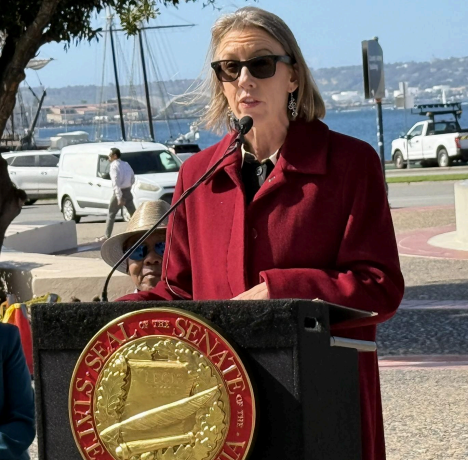
State Sen. Catherine Blakespear, shown at a February press conference in San Diego. Photo by Gary Warth
Blakespear is also a co-author of Senate Bill 417, the Affordable Housing Bond Act of 2026, introduced by Sen. Christopher Cabaldon. The bill passed the Senate 30-9 in January and is now before the Assembly.
Related to that measure, she introduced Senate Bill 1016 to ensure interim housing is eligible for bond funding.
“I’m trying to get interim housing in there because it’s the next rung up the ladder from homelessness,” she said.
Interim housing, including modular or prefabricated units, can be built quickly for temporary use.
“If there’s a parking lot in downtown San Diego that won’t be developed for five years, why not use that land to house people now?” she said. “How do we incentivize the creation of a bed or unit for someone who needs it tonight?”
In January, Blakespear also introduced Senate Bill 866, which outlines intent to enact the Emergency and Interim Shelter Capacity Act. While the bill does not yet specify funding mechanisms, she said its purpose is clear.
“It’s a crisis that people are living unsheltered on our streets,” she said. “There should be an emergency response that provides a place to stay and triages the problem.”
Measures addressing interim housing, encampments and shelter capacity intersect with regional coordination efforts led by RTFH, San Diego County’s federally designated Continuum of Care agency.