
June 2026
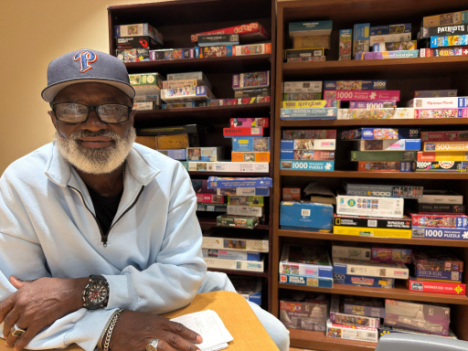
On just about any weekday morning, the sounds of dominos slapping on a table can be heard reverberating through the game room.
Ruby Toussaint is likely at the table or waiting his turn to play the winner. Someone else often is at another table working on one of dozens of jigsaw puzzles pulled from a shelf against the back wall.
“We’re usually pretty active in here,” Toussaint said. “It’s a minimum of six people. We have a little coffee hour, and we’ll engage in a few games, and we laugh and joke about certain aspects in life or speak about who is from the neighborhood, who’s still around, who’s passed away.”
At 72, Toussaint has been coming to the Gary & Mary West Senior Wellness Center in downtown San Diego for about 10 years.
From domino games to on-site dental care, the center has been called a model for all modern senior centers to follow, and regulars speak of one another as friends and even family members.
“We all grew up together here in San Diego, and a lot of us are from here, and a lot of us are not from here,” Toussaint said about his friends at the center. “We all interact with each other and sit here and just have a good time.”
But there are other reasons why people come to the center, and it may be why in mid-2026 Serving Seniors was on track to serve 14,000 clients, the most in its history.
Of the 5,108 homeless people who were living without shelter that year, 33% were at least 55 years old, a 4% increase from the previous year, and 52% were experiencing homelessness for the first time.
Nationwide, seniors are the fastest-growing segment of the homeless population, and about 20% of homeless people are older than 55.
“We have been seeing this spike since really before the pandemic,” said Melinda Forstey, president and CEO of Serving Seniors. “More older adults are falling into homelessness for the first time. That could be from the loss of a job, the loss of a spouse. Maybe they had a medical issue, or simply, it’s just increased costs on a fixed income.”
The average monthly income of a Serving Seniors client is just $1,200, and Forstey said many are living off of $10 a day to pay for food, transportation and other basic needs.
“This really points to the affordability crisis that we’re seeing across the country,” Forstey said. “More and more older adults are living alone. They don’t have familial support. We know health care costs are going up. Food costs are going up.”
To help with those day-to-day expenses, Serving Seniors provides 1.5 million nutritious meals annually, including home deliveries and on-site breakfast and lunch at locations from San Ysidro to Oceanside.
But even with help in making ends meet, more seniors are falling into homelessness. To help keep them off the street, Serving Seniors operates a 22-unit emergency shelter in collaboration with the San Diego Housing Commission and private funders.
Adding to challenges of an aging population and the affordability crisis, a shortage of affordable housing is making things even more difficult.
“Historically, it would take three to four months to get individuals into housing,” she said about clients in the shelter. “Now, we’re seeing upwards to six months, nine months, even over a year simply because there just is not enough affordable housing available.”
Rather than simply bemoan the lack of housing, Serving Seniors took action.
The organization has more than 700 homes for older adults, including an additional 95 added to a Clairemont property in March.
The housing helped hundreds of people who faced homelessness, but also revealed another frustration as the Clairemont project took eight years to complete, largely because of the labyrinth funding process.
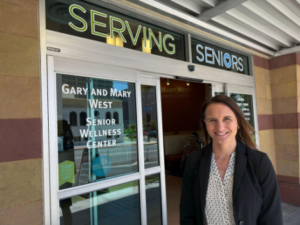
Serving Seniors President and CEO Melinda Forstey at the entrance to the Gary and Mary West Senior Wellness Center. Photo by Gary Warth
“That’s something that we really need to focus on as a community and at the state level to expedite affordable housing and to make it cheaper to build,” Forstey said, adding that there are seven different financing sources at the state level.
“What we would recommend ultimately is having one funding source, one application process,” she said. “That will really streamline the process and ultimately reduce costs and get more units online more quickly.”
Besides creating new homes, Serving Seniors has championed an effort to keep people where they already live.
A study conducted by Serving Seniors in 2021 found that many older San Diegans were struggling to make rent, but could stay housed with just another $300 a month.
That led to the creation of a shallow rental subsidy program, which Serving Seniors recently expanded to assist 130 people annually. Other cities have adopted similar programs since Serving Seniors launched theirs.
Serving Seniors has continued to expand and adapt to meet the community’s needs since its inception in 1970, the year when the California Commission on Aging approved a $15,000 grant to Bayside Settlement House to establish programs and services for older people.
The grant led to the creation of Cedar Community Center, which served 60 meals a day as part of Catholic Charities.
The center split from Catholic Charities three years later to become a separate nonprofit, and by 1977 it was serving 52,000 meals annually.
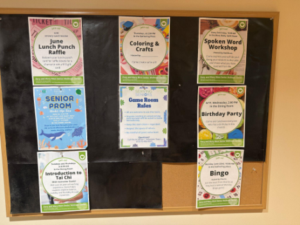
A board at the Serving Seniors game room shows a schedule of upcoming social events. Photo by Gary Warth
The organization’s name changed to Senior Community Center of San Diego in 1983, a name it kept until rebranding to Serving Seniors in 2014.
They began serving meals to seniors in shelters in 1996, and the organization dedicated its first transitional housing program for homeless seniors in 1998.
The nonprofit’s board approved a plan to build affordable senior housing in 1999, and the center partnered with Chelsea Investment Corporation to build its first affordable housing community in 2000.
Gary and Mary West gave $3 million to buy property at Fourth Avenue and Beech Street in 2008, and the Wellness Center with their names opened two years later.
Today, the Wellness Center offers meals, education classes and workshops, computers and printers, a dental center, on-site nurses and case managers, housing and rental assistance and social activities such as a Senior Prom, talent show, birthday parties and bingo, the most-popular activity.
Forstey said some clients initially come in for meals or to play bingo, but then find the many other services available from Serving Seniors’ 40 partners, including UC San Diego, SDSU, Point Loma Nazarene University, Father Joe’s Village, PATH and Sharp Healthcare, which provides an onsite psychiatric nurse twice a week.
Those services can be life-saving and life-changing, but activities such as bingo, dominos and crafts at the Wellness Center also play a vital role.
“Isolation and loneliness are so detrimental,” Forstey said. “And particularly since the pandemic, we know that those rates have gone up. And so this is an opportunity for folks, especially if they are living alone and not in touch with their family. They can come here, they can meet their friends for a meal, and we can become their de facto family, essentially.”
“We do things up here just to kind of stay out of trouble and don’t get into no mischief,” Toussaint joked, adding that he and his friends like to spread the word about the Wellness Center when they’re out in the community.
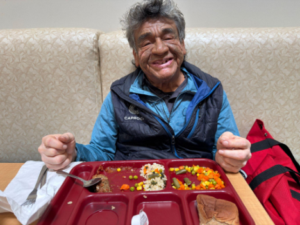
Nelson Chicas, shown finishing lunch in the cafeteria, is a regular at the Wellness Center. Photo by Gary Warth
Nelson Chicas, 67, visits the Wellness Center almost every day.
“I’m trying to establish some roots in the community because I don’t know anybody,” he said. “I’m basically just a rolling stone in the desert.”
Chicas was homeless for five years, living in his car and in a shelter before being housed, and he credits Serving Seniors and Third Avenue Charitable Organization with connecting him with services that helped him overcome homelessness.
“The only people I know are the people I frequently see here at the senior center,” he said. “It does become family because, whether you like it or not, we’re all lonely. Everybody that comes here needs someone to talk to.”
Chicas said everyone at the center tries to help one another, and he enjoys volunteering during meal service. For fun, he likes to play table tennis.
“There was only Asian people playing, and they didn’t speak English,” he said. “And I’m the only Latino who goes in there. So now they’re learning Spanish, and I’m learning Chinese.”
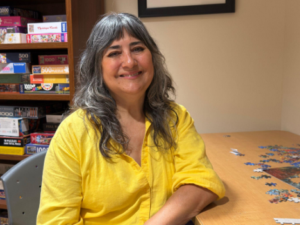
Gabby Mejia is a regular client and volunteer at the Wellness Center, where she usually spends four hours each day. Photo by Gary Warth
Gabby Mejia has been coming to the Wellness Center almost every day since retiring two years ago.
“Everybody knows me,” she said. “I love to be here with the people. It makes me happy to serve them.”
Mejia spends about four hours each day at the center, where she volunteers as a food server and helps with bingo or arts and crafts projects.
“I come mostly to socialize,” she said. “To me, it’s like a party every single day, to be honest with you.
“I just come and enjoy the events that they have,” she continued. “Like this coming week, we’re going to have the Senior Prom. We select by votes the queen and the king. And every month, we have a social ice cream day after lunch. We get together, chat and socialize and have ice cream. That’s why I like to be here, because it’s a lot to do.”
Mejia joined a group that traveled to a Balboa Park museum in March, and last year they went to Safari Park.
“Usually I’m alone at home, so when I come here, my adrenaline is always high,” she said. “I’m just happy. I like to talk. I like to socialize. To me, it’s the most important thing to do.”