
Aug. 5, 2026
San Diego was booming in 1927, but there were growing pains.
World War I had ended less than a decade earlier, and the military town was now a major commerce hub as the nearest American port to the Panama Canal, which opened 13 years earlier.
Social services in the city could not keep pace with a population that had grown from 35,000 to 120,000 in just 10 years, however, and many people in need were at risk of being overlooked.
Members of the Episcopal church responded that year by creating social welfare programs to serve their marginalized neighbors who were struggling, and their work expanded to help more community members in following years.
Episcopal Community Services officially incorporated in 1955, the year the organization received its first contract with San Diego County to provide counseling and jobs for men released from prison.
Today, Episcopal Community Services serves as a network of independent regional nonprofit organizations affiliated with the Episcopal Church and delivers about $45 million annually to fund countywide health and human services to 10,500 San Diegans.
As the organization approaches its 100th anniversary of its first programs, ECS has plans to open a new facility for substance-use disorder treatment and expand its behavioral health program for children.
About 63% of its funds go toward early child development programs, including Head Start for 3- to 5-year-olds and Early Head Start for pregnant women, infants and toddlers, which together receive 54% of the funds. ECS also has a state contract for early education preschool, and about 6% of its funds go toward housing and supportive services for people facing or at-risk of homelessness.
“We’re all about breaking barriers and creating opportunities for people in our community,” said ECS CEO Elizabeth Wilberg. “I think ECS in a number of ways helps our clients to make strong starts and strong restarts in life.”
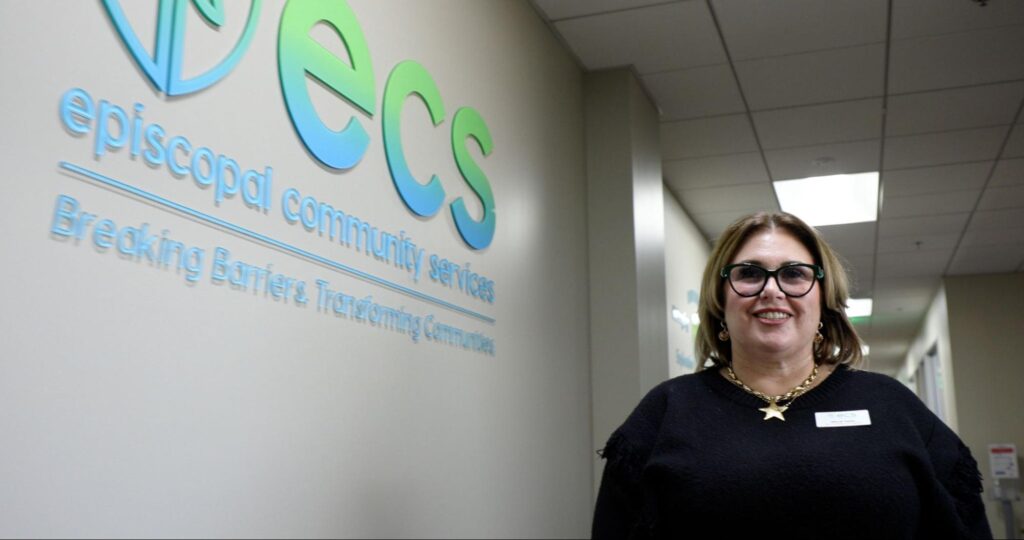
Stacie Perez, former vice president of programs at ECS.
“That goes for children who are just starting out and adults who were steered off course by something in their lives that resulted in addiction or homelessness,” she added.stance
“Everywhere you walk or look around in San Diego, we see a lot of our unhoused neighbors,” said Stacie Perez, who until recently was vice president of programs at ECS and now is CEO of Volunteers of America, Southwest. “And it’s a huge concern for those of us living here, and especially for those of us working in social services.”
Perez said ECS has numerous programs that address homelessness and rehabilitation, including the Central East Regional Recovery, an outpatient substance-use disorder treatment program.
“We not only provide substance-us disorder treatment, but we also provide some supportive housing in the recovery residence so clients who come to us for treatment also have a safe place to live,” she said.
ECS also has two safe havens that provide residential treatment for people with severe mental illness and substance use disorder.
The Community Harm Reduction Team Safe Haven serves up to 22 homeless people living with chronic substance use conditions and mental health issues. Located at Veterans Village of San Diego, the C-HRT Safe Haven operates in partnership with the County of San Diego, which covers operating costs, and the City of San Diego, which covers facility costs.
Family Health Centers of San Diego provides ongoing care coordination, case management, and support services to clients from the C-HRT safe haven as needed.
The 19-bed Uptown Safe Haven provides transitional housing and supportive services to chronically homeless single adults with moderate to severe mental health issues.
ECS partners with Community Research Foundation to provide Uptown Safe Haven clients with housing, employment counseling, educational guidance, disability income enrollment assistance and a manageable mental health plan. Clients participate in weekly community meetings and engage in art workshops, group meals, pet therapy, monthly barbeques, field trips and holiday celebrations.
Wilberg said clients may stay at a safe haven from six months to two years.
“We’re talking about human beings, and it can take humans a while to learn new, healthy habits,” she said. “Some of our clients need support with things that we might take for granted, like how to make a budget, how to get a job, how to do your laundry, how to make your own meals.
“It really depends on the experience that they’re coming from, but we meet each of those clients where they are and tailor a plan for them.”
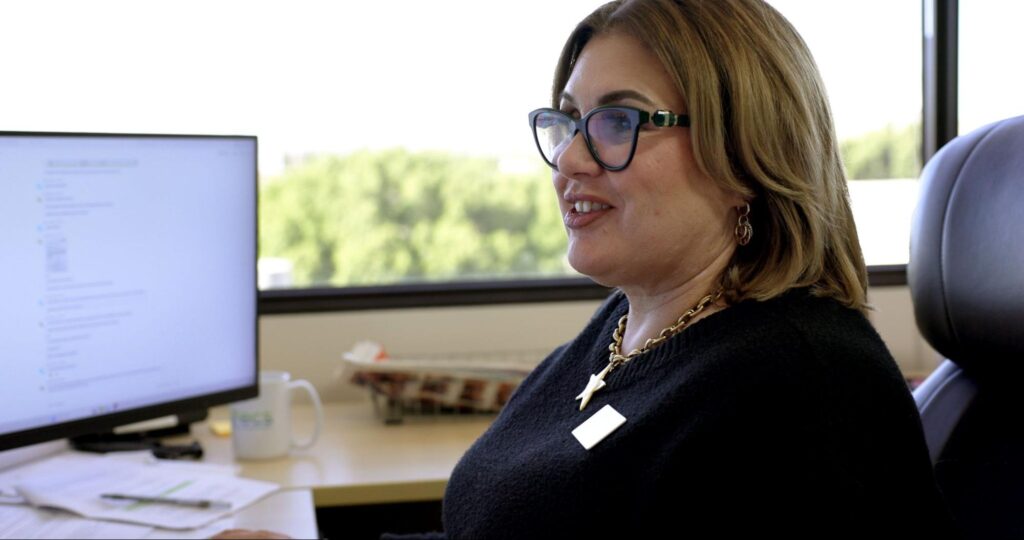
Former ECS Vice President Stacie Perez shown at work in her office.
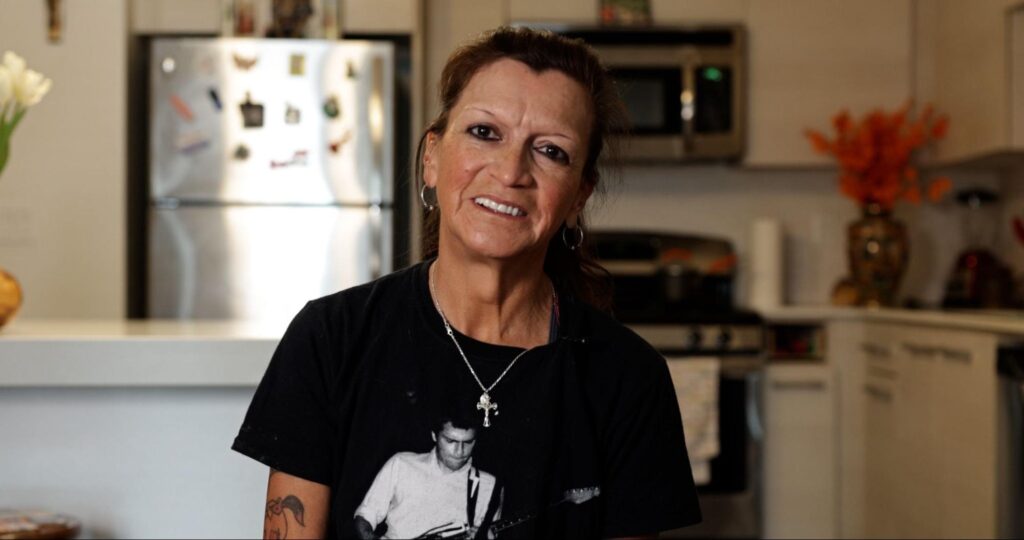
“When I was homeless, I felt hopeless,” said Maria, 56, a client who found housing and help through ECS. “I felt worthless. I felt like a nobody. And people would look at me like I was a disgrace, and that really broke my heart because I came from a very good Catholic family.”
Maria said she had learning disabilities and experienced early childhood trauma that included sexual abuse and a feeling of a lost identity after learning she was adopted.
Pregnant at 17 and the mother of two at 19, her life began to spiral when she started using drugs at 23.
“I hooked up with a singer in a rock band, and he was a meth cook,” she said. “I lived the sex, drugs and rock-and-roll lifestyle.”
That lifestyle did not include parenthood, and Maria said she lost her two children. More boyfriends, and more abuse, came in the years that followed. Maria was in the throes of addiction and saw no way out.
“I never went a day without drugs,” she said. “The drugs helped me escape all the trauma I’d been through with men. I had to numb myself.”
Maria said she bounced around different cities, was treated at three mental hospitals and was homeless for six years in San Diego.
And then, for reasons she can’t even explain, she got clean on March 19, 2022 after being admitted in an emergency room at Lake Elsinore and hospitalized for seven days.
“I had 30 years of nonstop drug use and I never stopped until that day,” she said.
Maria said she returned to the “dope house” where her boyfriend was living and remained for another month, but still stayed clean. She then checked into rehab.
And then checked into another rehab facility. And then another. Maybe 20 or 25 in all, she said about the facilities that offered support and a temporary place to stay.
“I went to rehab because they kept me off the streets,” she said. “I went all over Southern California. They kept a roof over my head. I stayed sober the whole time.”
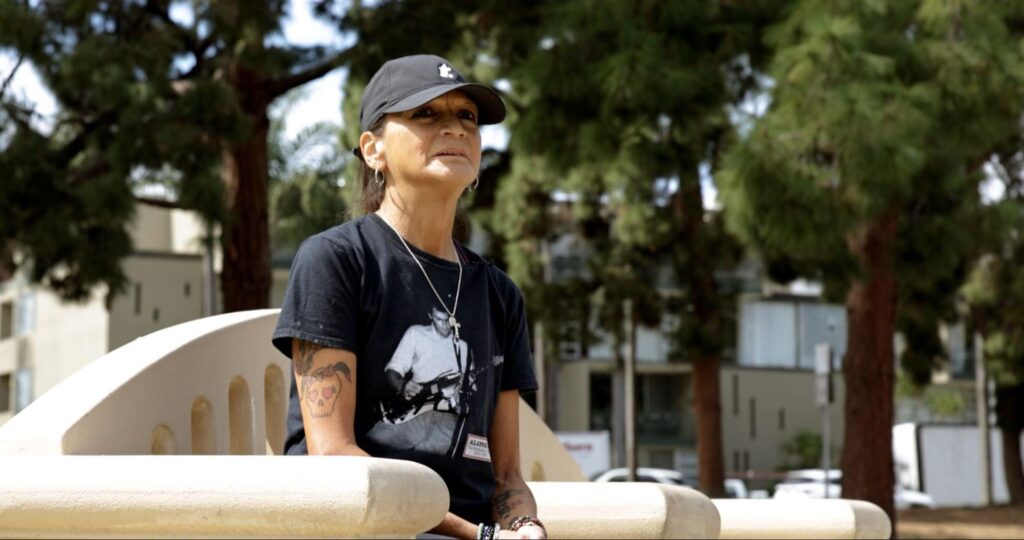
Episcopal Community Services client Maria went through several residential rehab programs before finally finding permanent housing through ECS.
Sobriety alone, however, does not solve homelessness. Maria said it wasn’t until she was connected to Downtown IMPACT, a service of ECS’s partner Community Research Foundation, that she found real stability.
Downtown IMPACT uses the evidence-based Assertive Community Treatment model that offers psychiatric care, medication management, substance use treatment, nursing, psychosocial rehabilitation, benefits coordination and support with daily living activities.
Perhaps most notably, it provides all clients with housing within the first week of enrollment.
“After going to 25 rehabs, I finally found one that worked,” Maria said.
Perez said the safe haven program was a good fit for Maria.
“I think Maria, like many of the clients we work with, came to our program with years and years of trauma and other things that have happened in her life,” she said.
“So Maria and other clients definitely benefit from being at a safe haven because for some of them, it is the first time in their life where they’ve actually lived in a safe environment so they can start healing both maybe their addiction, treatment for mental health, and other things that they’re dealing with.”
She also credited Maria herself with playing a vital role in her recovery.
“Maria has a lot of her own internal strength and intelligence,” Perez said. “And she was really, really driven from the start. She took full advantage of all this program and services that we had to offer.”
One year after moving into her home, Maria said she is a changed person.
“I’m not the same person I used to be,” she said. “I don’t even know who that person was, to be honest. I once told myself, ‘I never see myself getting clean.’ I don’t need drugs any more in my life. I’m content in my life.”
Maria said the combination of wrap-around services and the stability of housing has changed her life.
“I’ve had so much therapy, but having my own place has made me more complete,” she said. “It’s been a blessing, and I’m very grateful. I don’t take anything for granted today. I live my life to the fullest.”
Like Maria, Kim said her life also turned around with help from the ECS Central East Regional Recovery Center.
“I had lost everything,” she said in a video on the ECS website. “I had lost my place to live. A vehicle. I lost my job. I was clearly on my way to jail if I didn’t turn myself around.”
Kim said drug addiction had ruined her life, and she wanted a change. That’s when a friend told her about ECS.
“I came to ECS and it’s been amazing ever since,” she said. “A total 100% turnaround.”
Kim described the staff as warm and helpful and the environment as a place where nobody judges people, allowing clients to talk freely.
She has returned to work in accounting, has her car back and was living in an apartment with an ECS alum when the video was made.
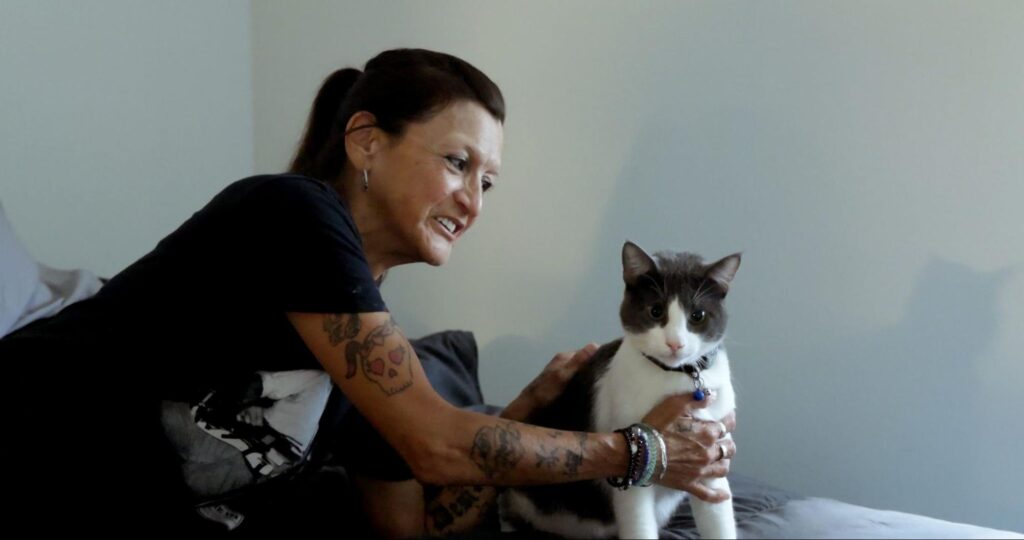
Maria, shown at home with her cat, overcame homelessness and addictions and is one of many people who had been helped by Episcopal Community Services.
“I’ve had family members say, ‘Kim, you’re a different person,'” she said. “And I am a different person. I feel good and I know that I’m doing the right thing. It was a long haul, but this is where I need to be and where I’m more comfortable, working and having a job.”
As ECS approaches its 100th anniversary, the organization is finding new ways to serve the community.
Wilberg said a new 49-bed residential substance-use disorder treatment center will open in El Cajon in the fall of 2027.
The program will include formerly homeless people who will exit into ECS’s outpatient program and temporary or permanent housing, she said.
“We felt that we wanted to do something about this crisis of shortage of beds in the region,” Wilberg said. “We were seeing over and over again that some of our clients in our outpatient program needed a higher level of care, and there was just nowhere for our staff to send them. It was scary and frustrating, and we thought, ‘Gosh, we need to be part of the solution here.'”
Also next year, ECS is expanding its children’s mental and behavioral health program, Para Las Familias, which will grow from serving 100 children to 430. The program now serves children up to 5 years old and in the future will serve children up to 12.
“The County asked us if we would take it county-wide, and we said, ‘Of course,'” Wilberg said, adding that the new program will be somewhere in North County at a location not-yet named.