
Dec. 1, 2025
Among the efforts to reduce or solve homelessness, one emerging trend is proving to be not only consistently effective, but also far less costly than other practices.
Known as diversion strategies, the approach focuses on people in the early stages of homelessness and provides a variety of solutions to challenges that otherwise could compound into more serious issues that are harder to overcome.
The approach is showing success locally through an initiative spearheaded by RTFH (the Regional Task Force on Homelessness), which has helped coordinate help that includes short-term case management, assistance in finding housing, connections to various available resources and financial aid to pay deposits, back rent, utility bills and security deposits.
Without the assistance, people dealing with financial issues or other challenges could lose their home and end up living in a vehicle, a shelter or even on the street, possibly sliding into a deeper cycle of homelessness.
A 2022 study in Washington state found diversion services had a positive impact on families who were facing homelessness. Overall, families who received the services were more likely to move into permanent housing than families who received other types of services.
San Diego County has seen similar success on a smaller scale. A report released by RTFH in December 2024 showed that over 12 months, 489 households had received diversion services, and 93% had moved into permanent housing and 96% were still housed.
The average cost for rental assistance or deposits was $1,452 for each of the 597 individuals served, or $3,150 for a household. The effort resulted in an estimated savings to taxpayers of about $1.27 million by diverting people away from the more-costly shelter system.
The release of the report in December 2024 coincided with an RTFH monthly report that showed more people had exited homelessness to permanent housing than entered homelessness. It was the second month in a row that showed a positive result and followed 33 months of discouraging reports that showed more people entered homelessness than found housing.
“When our team looked at the data more specifically, this was a direct result of this model and this initiative,” said RTFH Chief Operations Officer Lahela Mattox. “We saw a nine percent increase in November and a ten percent increase in December of 2024, which really demonstrated and proved that this is a model that is effective in our community.”
The new encouraging results were backed up from the results of the January point-in-time count that showed the homeless population had declined throughout the county.
RTFH first began working on diversion strategies in 2018, the year it contracted with Ed Boyte, who at the time was at the Cleveland Mediation Center, to provide training for diversion strategies in San Diego.
After launching its pilot program with an annual budget of $300,000, RTFH significantly ramped up the effort in 2023 with $1.1 million from philanthropic organizations and local governments.
“With that increase in funding last year, we’re really able to scale it and prove that this is a model that we should be utilizing even more,” Mattox said.
Diversion includes connecting people with their own resources to immediately resolve a crisis without going into a shelter or long-term housing.
It also includes housing problem-solving, a technique used by practitioners to help people find immediate, safe and appropriate housing options.
“This is where we’ve really honed in with Ed and some of our providers to become experts to engage in these conversations,” Mattox said.
The approach also includes resolution strategies that provide financial assistance to support households through a flexible funding pool.
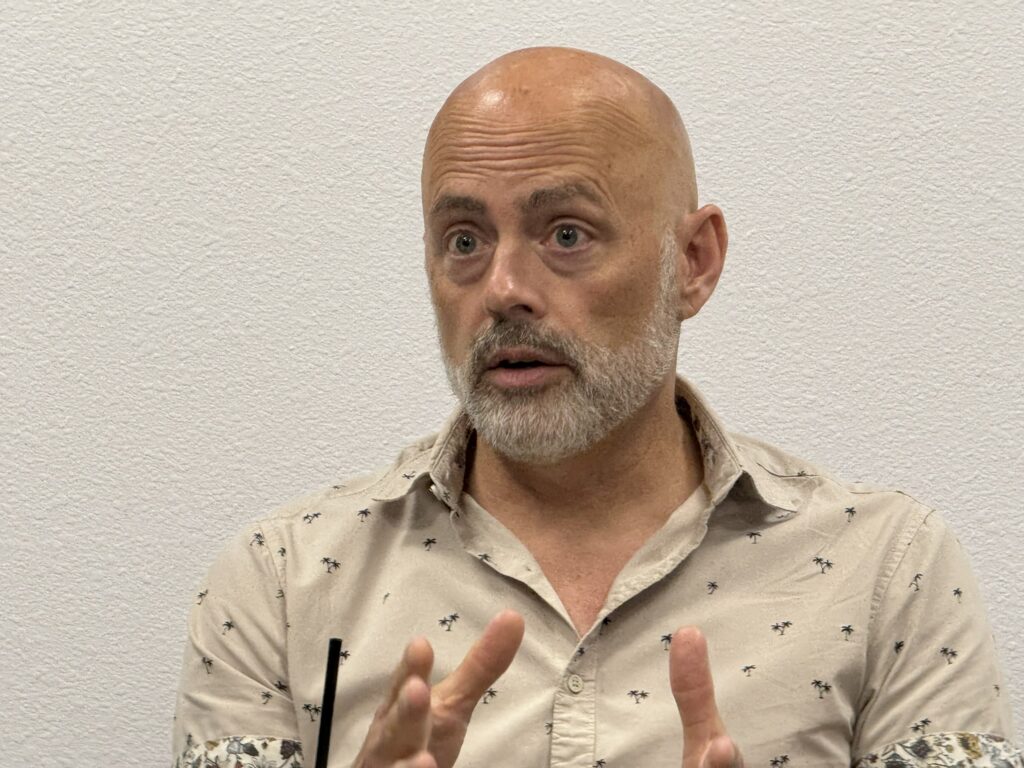
Ed Boyte has trained San Diego professionals in diversion strategies since 2018 under an RTFH contract. Photo by Gary Warth
Since expanding the initial pilot program, RTFH has contracted with nine agencies throughout the region and partnered with an additional 19 agencies. Boyte has formed The Listening Group to provide training and support for organizations addressing homelessness.
“We did virtual weekly office hours to provide one-on-one coaching and case conferencing to really ensure that people were understanding this model and this practice and really embedding it within their organizations, and Ed has continued to provide that support to our community,” Mattox said.
“We also host train-the-trainer sessions so that staff are trained as well to do the training and they can continue that within their own organizations.”
In one of several trips to San Diego County this year, Boyte also met with grassroots groups to share insight about the values of diversion.
“It’s grounded in the approach of doing human-centered work,” Boyte said. “And from that, we work with people to then begin to figure out what they need to get to a safer, more stable place. And we support them in doing that. If we don’t help them in that way, if we don’t support them, we’re just throwing money at it.”
Boyte said part of diversion training involves what he calls active and empathetic listening.
“It’s working alongside someone in a housing crisis to help them begin to figure out and articulate what has worked previously, what are the obstacles, what are the goals, and how to obtain those goals,” he said.
Boyte said it’s also important to help people recognize their own abilities to overcome challenges they face.
“What are their strengths and skills?” he said. “I’m more interested in how people were able to avoid homelessness than understanding what causes this particular case of homelessness.”
Those conversations could reveal job skills and relationships with friends and family who can offer support, leading to immediate housing solutions.
Daniel Sturman, encampment initiative program manager with RTFH, said outreach workers should have a 30-minute discussion with someone before talking about resources.
“Don’t ask, ‘Do you want rental assistance?’” he said, anticipating that someone would immediately say that they do. Instead, he suggested having a longer conversation that could reveal that someone had a setback that affected their livelihood.
Geri Schroeder, program director of SBCS (formerly South Bay Community Services), attended a session with Boyte during one of his San Diego visits and recalled how her team used diversion strategies to help a client she called Julio.
“He came to our organization looking for assistance, looking for housing,” she said about Julio, a senior who was living in his truck and had intense medical needs.
“Our staff had a diversion conversation with him,” Schroeder said. “We tried to figure out if he had any support system here in the area. He wasn’t able to identify anyone here, but we helped him find a brother he had in the Baltimore area.”
Staff members asked if he ever thought of staying with his brother, and Julio said he thought he could, but was hesitant to ask.
Using a diversion technique, someone asked Julio if he would help his brother if the shoe were on the other foot, which made Julio more open to the idea.
“Our staff was able to help him call his brother in Baltimore, and when his brother heard he had been sleeping in his truck he said, ‘Oh my gosh, he can come here because we have an extra bedroom,’” she said.
Julio was concerned about leaving his doctor in San Diego, but staff members worked with him to have his physician transfer his medical records to Baltimore.
They also put him up in a hotel room, bought him a plane ticket and a gas card to drive to Los Angeles for his flight to Baltimore. Money also was wired to Baltimore to help him get settled and buy new clothes.
In all, the effort cost $2,500 in diversion funds, Schroeder said.
Follow-up calls have found that he was doing well, and Schroeder said they received a photo of him and his brother in front of their home.