
Feb. 10, 2025
The Point-in-Time Count happens, as the name implies, just one day each year and is intended to capture how many people in San Diego County are living in shelters or outdoors without a home.
Preparing for that one day, however, takes months of planning — including volunteer recruitment, training sessions, and coordination with partners that begins as early as August.
And then there are the socks.
Donated by the clothing company Bombas, the socks are part of the company’s long-standing commitment to supporting people experiencing homelessness. For every item sold, Bombas donates one item to organizations serving people without housing. The 5,000 pairs of socks provided to RTFH arrived in the fall and were stored in 20 large boxes until December.
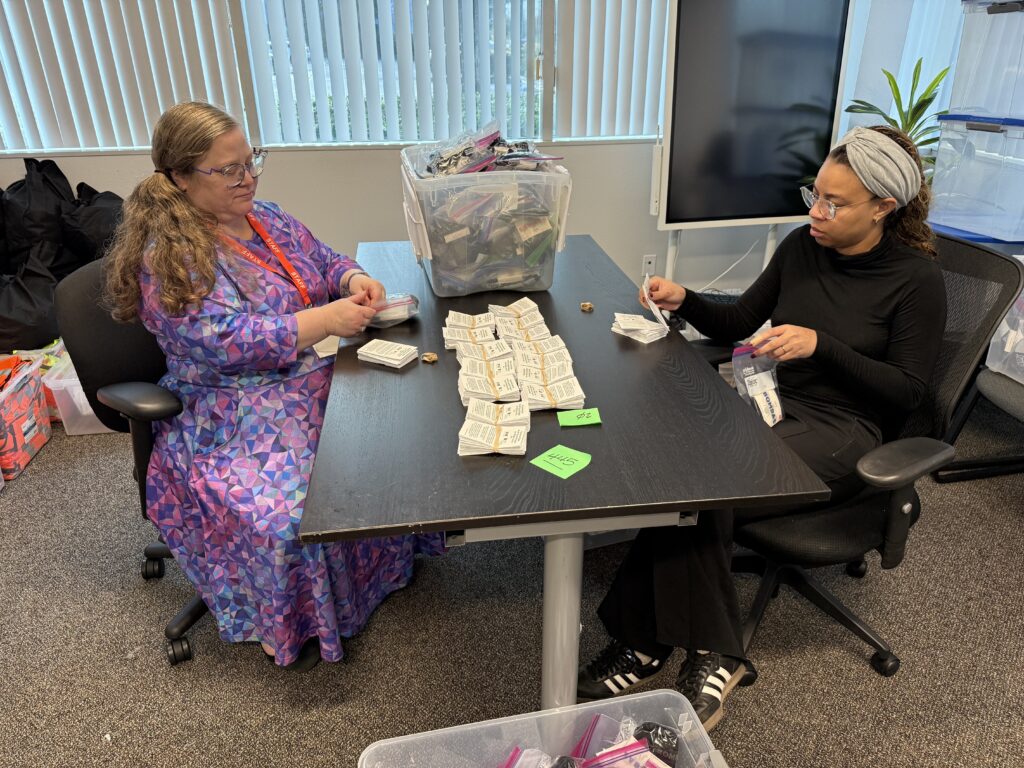
In early January, RTFH staff members and partners gathered over several days at the nonprofit’s office to prepare the items that would be distributed during the Point-in-Time Count.
At one table, volunteers organized socks and $10 gift cards to 7-Eleven. At another, staff members folded hundreds of sheets of paper into small pamphlets listing local resources available in different areas of San Diego County.
A whiteboard in one room showed the precise distribution of the pamphlets: 1,968 for the Central region; 844 for North Central San Diego; 540 for Inland North County; 440 for Coastal North County; 380 for South County; and 560 for East County.
The socks, gift cards, and pamphlets were then placed into individual bags, boxed, and picked up by the site coordinators for their deployment sites, where they would be distributed to the approximately 1,700 volunteers participating in the Jan. 29 count.
Volunteers signed up over several weeks and completed online training, while site coordinators — who manage operations at each deployment site — attended in-person training at the RTFH office on Jan. 15.
RTFH Continuum of Care Coordinator Alma Vasquez explained that there are 58 count sites throughout the county, including six youth sites, five Caltrans sites, 12 safe parking sites, and two safe sleeping sites.
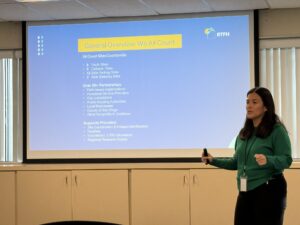
Alma Vasquez speaks to deployment site coordinators during a training session at RTFH. Photo by Gary Warth
More than 50 partner organizations participate in the count, including faith-based groups, homeless service providers, city jurisdictions, public housing authorities, local businesses, the County of San Diego, and other nonprofits and coalitions.
“We definitely have to work together as a community to address homelessness,” Vasquez said. “It has to go beyond just those who work directly with people experiencing homelessness every day.”
Vasquez also explained how volunteers are assigned to teams and deployed to specific areas. Locations are prioritized using three levels, with the highest priority given to areas where people experiencing homelessness were identified during the previous two counts.
With the count just two weeks away, coordinators were also briefed on preparing for the early-morning deployment — including setting up breakfast stations for volunteers and ensuring maps, socks, safety vests, flashlights, and gift cards were ready.
“We just want to make sure we have an effective and accurate count,” Vasquez said.
All of that preparation leads to one early morning when volunteers fan out across the county — not just to count people, but to help ensure they are seen.