
Service members often find themselves facing a new type of battle after leaving the military, with many trouble adjusting to civilian life and sometimes facing substance use and mental health issues, trauma, feelings of isolation and a lack of support systems.
Veterans at one time were considered to be 50% more likely to become homeless than other Americans. In one of the bright spots in efforts to address homelessness, however, significant progress has been made in helping veterans overcome those challenges, get connected to health services, access benefits and find housing.
Motivated by a widely held agreement that people who served their country should never be homeless, federal and local efforts have contributed to the decrease over the past two decades.
According to point-in-time count data compiled by the U.S. Department of Housing and Urban Development, veteran homelessness has declined by about 56% since 2009 and was at 32,495 in 2025, a 1% drop from the previous year.
HUD attributed the 1% drop to 333 fewer unsheltered veterans than in the previous year.
The 2024 count saw a 7.5% decrease from the previous year, and the 56% drop over 16 years represents more than 40,870 veterans who once were homeless.
Locally, the 2026 count saw a 1% increase in veteran homeless, an increase of five more people. The count also found more veterans were staying in shelters rather than on the street.
The 359 veterans counted living without shelter was a 12% decrease from the previous year, and the 289 in shelters represented a 23% increase.
The 2025 point-in-time count saw unsheltered veteran homelessness down 25% while another report found 20 veterans were housed for every 10 who fell into homelessness on average that year.
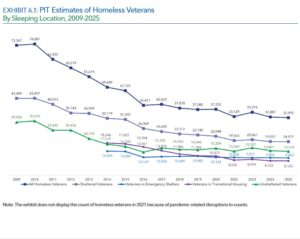 A chart from the US Department of Housing and Urban Development’s report on the 2025 point-in-time count shows the decline of veteran homelessness since 2029.
San Diego has a large veteran population and is home of Veterans Village of San Diego, which was formed in 1981 to serve homeless veterans. VVSD launched Stand Down in 1988 as an outreach event to connect veterans with a variety of services, and it has been replicated in more than 200 cities across the country.
VVSD continues to provide a variety of services to help veterans overcome homelessness.
In 1987, the U.S. Department of Veterans Affairs formed Health Care for Homeless Veterans as a hub for housing and other services, and the VA also operates the National Call Center for Homeless Veterans.
The VA adopted Housing First as a policy in 2012 and houses many veterans with HUD-Veterans Affairs Supportive Housing (VASH) vouchers. Since 2008, HUD has awarded more than 116,000 VASH vouchers to veterans.
Between 2024 and 2025, the number of homeless veterans decreased by one percent. This decrease in the number of homeless veterans was largely driven by declines in the number of unsheltered veterans, which declined by 333 veterans.
Over the longer term, the number of homeless veterans has declined by 56 percent since the data were first reported in 2009. This represents a total decrease of more than 40,870 homeless veterans in the last sixteen years.